Fourteen Years: 1868-1882
The Barn
Let’s talk about the “Chinese Problem.” By 1869, the Central Pacific’s Chinese workforce had grown to 11,000, which was 80 percent of the CP workforce. The Central Pacific was in a big rush to lay tracks, weren’t they?
The Mack
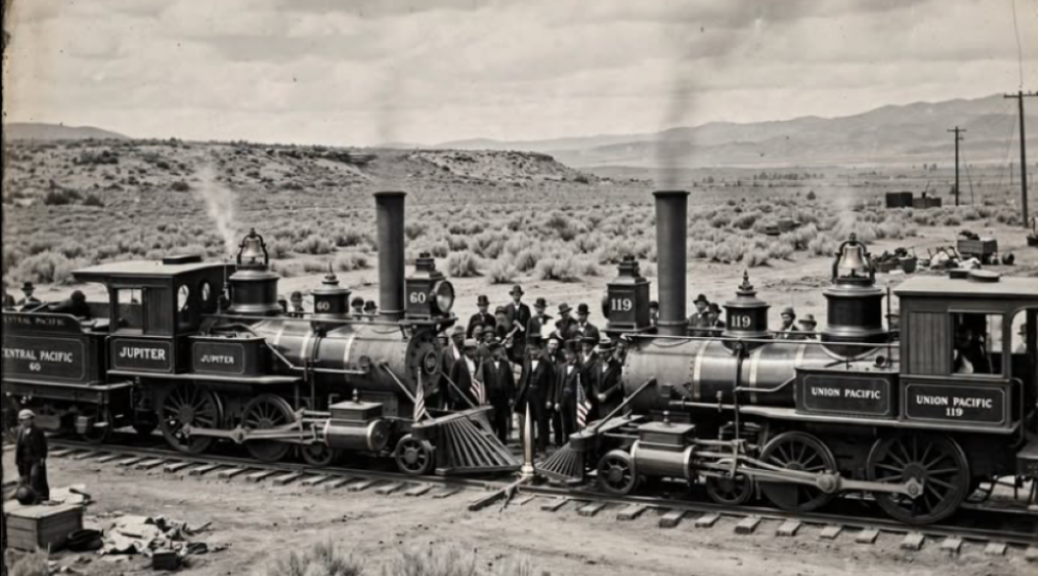
Right, the transcontinental railroad would be completed when the Central Pacific met the Union Pacific at Promontory Summit, Utah, on May 10, 1869. And those miles of track were a very lucrative endeavor for the Central Pacific and the Big Four… Crocker, Hopkins, Stanford, and Huntiington.
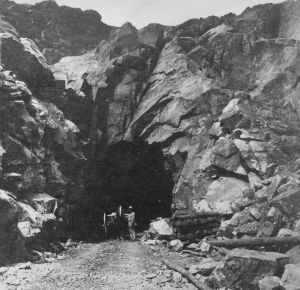
The Central Pacific began seriously experimenting with Chinese laborers in 1865, initially hiring a relatively small group because Charles Crocker and the other Central Pacific leaders were having great difficulty recruiting and retaining enough white workers in California. The Chinese workers proved effective, and the experiment expanded rapidly.
And there’s an important irony that connects directly with what we’ve been calling the “Chinese Problem.” The Chinese workers went from being a labor force that many Central Pacific managers initially doubted could do railroad construction to being indispensable to completing one of the country’s most celebrated national projects. Yet almost immediately afterward, Chinese immigration and Chinese workers increasingly became characterized in California politics as a social and economic “problem.”
The Barn
What relationship did the Burlingame-Seward Treaty establish between China and the United States? And when was the treaty ratified?
The Mack
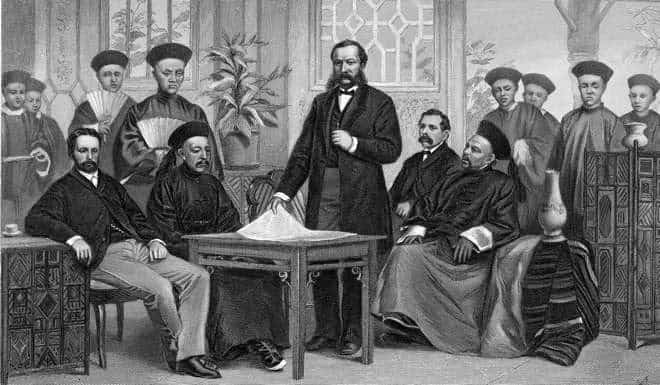
The Burlingame–Seward Treaty was negotiated and signed in Washington, D.C., on July 28, 1868, and ratifications were exchanged on November 23, 1869.
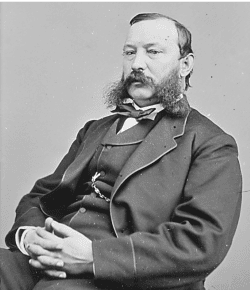
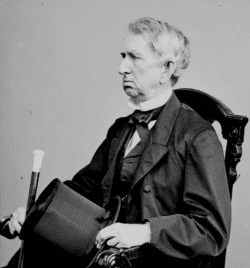
The treaty was negotiated by Anson Burlingame, representing China, and Secretary of State William H. Seward for the United States. Crucially, it recognized the “inherent and inalienable right of man to change his home and allegiance” and encouraged voluntary migration between China and the United States.
So at almost exactly the moment the Chinese railroad workforce was demonstrating its enormous economic value, the official policy of the United States was actually moving toward freer Chinese immigration—not exclusion.
The bargain was essentially reciprocal:
Americans could travel, reside, trade and pursue opportunities in China; Chinese could travel and reside in the United States.
Seward’s great foreign-policy objective was American access to China—a potentially enormous market. The United States was competing with Britain and the other European powers for trade and influence there. The State Department’s own historical account describes American objectives as gaining access to profitable Asian trade and increasing American influence in China.
But there was another reason that is especially pertinent to our conversation.
Washington actually wanted more Chinese labor
The State Department’s history says explicitly that the treaty ensured a continuing supply of inexpensive Chinese immigrant labor for American businesses and that American industrial leaders initially celebrated it for precisely that reason.
Even more strikingly, when the treaty was still awaiting Chinese ratification, the new Grant administration’s Secretary of State, Hamilton Fish, actively pushed for ratification. A later State Department diplomatic history records Fish welcoming Chinese laborers coming by the “thousands” and predicting that their movement eastward would “continue and increase.”
The thinking wasn’t:
We needed 11,000 Chinese to build the Central Pacific.
It was closer to:
Chinese labor helped build the Central Pacific. Why shouldn’t Chinese labor help build the rest of the American economy?
The Barn
That seems like two trains on a collision course. Doesn’t this mean that in 1869 there were already two very different American views of Chinese immigration?
The Mack
Yes. California had experienced anti-Chinese agitation since the 1850s. An 1868 federal report describes California politicians trying to restrict Chinese immigration while merchants, manufacturers and capitalists argued that Chinese labor and the China trade were extremely important to the state’s economy.
Meanwhile, the national government was looking westward across the Pacific and seeing something different:
China = trade + markets + diplomatic influence + labor.
So Washington ratified a treaty guaranteeing essentially free voluntary migration at almost precisely the moment when the particular labor shortage that had made Chinese workers indispensable to the Central Pacific Railroad was disappearing.
The Barn
Would you say the Chinese Problem boils down to employers versus laborers? Or, if we wanted to put names and faces on it… capitalists like Charles Crocker against labor leaders like Denis Kearney.
The Mack
Yes, and I think that’s a cleaner way of understanding the early conflict than starting with racism alone.
A remarkable 1868 federal report from California practically says this explicitly. It describes a large and influential group of “merchants, manufacturers, capitalists” who valued Chinese labor and trade. It then describes white laborers objecting because Chinese workers supplied the labor market and frustrated workers’ attempts to control the price of labor. The author even states the economic conflict plainly: workers naturally try to obtain as much as possible for their labor, while “capitalists should endeavor to cheapen labor as much as they can.”
So by 1869 you can reasonably picture two economic interests:
Employers/capital: California needs workers. Chinese labor is reliable, relatively inexpensive, and expands what we can build, manufacture, mine and grow.
White labor: The Chinese willingness to work for less increases the supply of labor, weakens our bargaining power, and makes it harder for us to demand higher wages.
The Barn
The Burlingame-Seward Treaty opened the gate and the Chinese Exclusion Act slammed it shut, and in the intervening 14 years around 200,000 Chinese arrived in the United States. How did our national government so thoroughly and completely change their attitude during that span? What happened?
The Mack
Initially, the Burlingame-Seward Treaty reflected a remarkably optimistic national view. Washington wanted commerce with China, good relations with the Qing government, and access to Chinese labor.
The railroad had demonstrated that Chinese workers were reliable and productive. Once it was finished, Chinese labor didn’t disappear. Workers moved into agriculture, mining, factories, construction, laundries, domestic service and additional railroad building throughout the West.
But then came the Panic of 1873 and the long economic depression that followed.
Unemployment rose. Wages came under pressure. And suddenly the Chinese worker—who had been praised when labor was scarce—was portrayed as a threat when labor was plentiful.
The political argument became brutally simple:
“Chinese workers are taking white men’s jobs and depressing wages.”
And the rallying cry of Denis Kearney and the Workingman’s Party:
“The Chinese must go”
The Barn
The Burlingame-Seward Treaty triggered a surge in Chinese immigration. Is it also true that the Panic of 1873, also known as The Long Depression, triggered the Chinese Exclusion Act?
The Mack
Yes—with an important qualification. I think that is a very useful way to frame the story, provided we say the Panic of 1873 accelerated and politically empowered an exclusion movement that already existed, rather than literally caused it.
Your two bookends work rather well:
Burlingame-Seward helped open the gate wider.
The Panic of 1873 supplied much of the economic and political energy that eventually slammed it shut.
That last point is important. The Panic didn’t immediately close the gate. Quite the opposite: large numbers of Chinese continued arriving while economic conditions were deteriorating.
And that created an explosive combination:
More workers arriving + fewer jobs + falling wages + business failures + existing racial hostility.
The Barn
The Panic of 1873 certainly deserves more discussion. Next time?
The Mack
I’ll be here, looking forward to it.