Doing this hot rod building and restoration stuff, either as a hobby or as a business, is so rewarding because it’s a creative endeavor. You’re bringing a vision that exists in your mind, through a planning stage and, finally, to a real physical product. As a Taoist might say, moving something from its Yin aspect to its Yang aspect.
But, damn… there’s always something. Especially when the creative process starts with a car or truck that is half a century old. There will be blood. And frustration. Rarely is anything simple and straightforward. Not complaining, mind you, problem solving is part of the fun. So with that in mind, we’ll share some solutions that might apply to your project as well as ours.
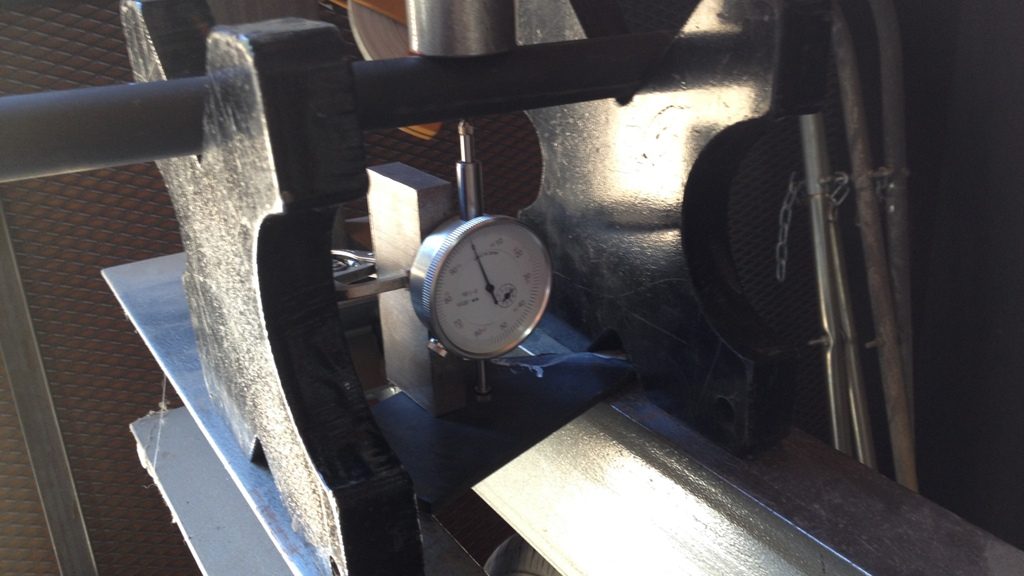
Even tools can cause headaches. Trying to straighten the HF bead roller shaft, which had a wobble in it.
During the process of working on our old cars and trucks, we have developed lots of favorite things: tools, equipment, websites, stores, and ideas. Even dumb ideas… why should you go down the same dead end that cost us time and money.
We don’t waste money, because it’s hard earned. We really prefer getting a good value for our money… if it’s a tool or equipment we think we’ll be using on most projects, we buy it. If it’s a one time problem we’re trying to solve then borrow it. No doubt it helps to live in Southern California because we are never far from resources.
One of the best resources anyone can find – no matter the endeavor – is a smart, experienced guy. Whether that’s your local owner/operator transmission shop or exhaust shop or machine shop, or just a friendly hot rodder who’s been doing it longer than you, these relationships will save you headaches and time and money.
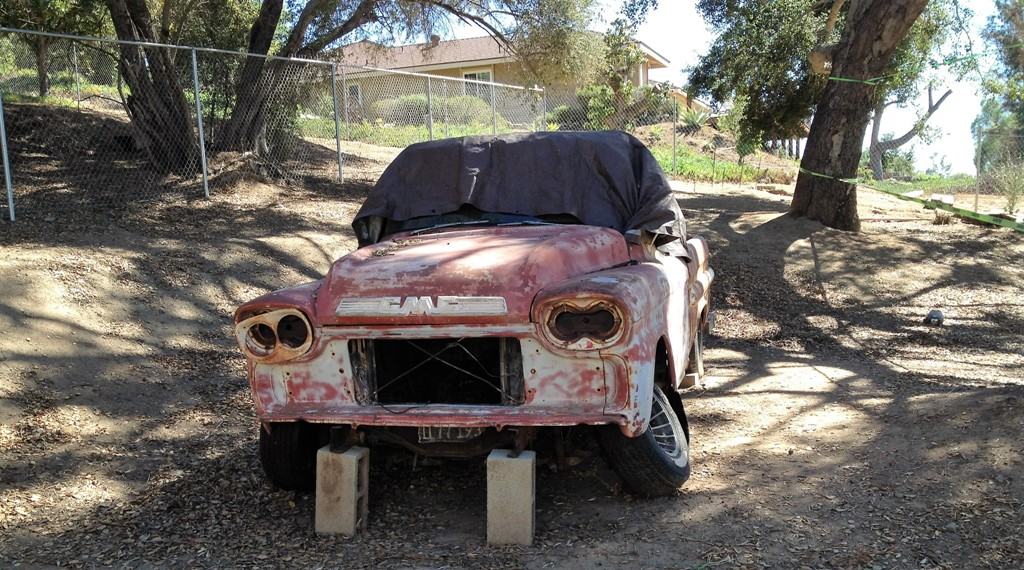
Alas, we decided to send the GMC Fleetside along to the “next guy.” Too many other projects, but I hope to see what becomes of that one.
*****
Besides the Apache, this is our other in-house build. It will be the culmination of all of our mistakes. Wait… did I say that right.
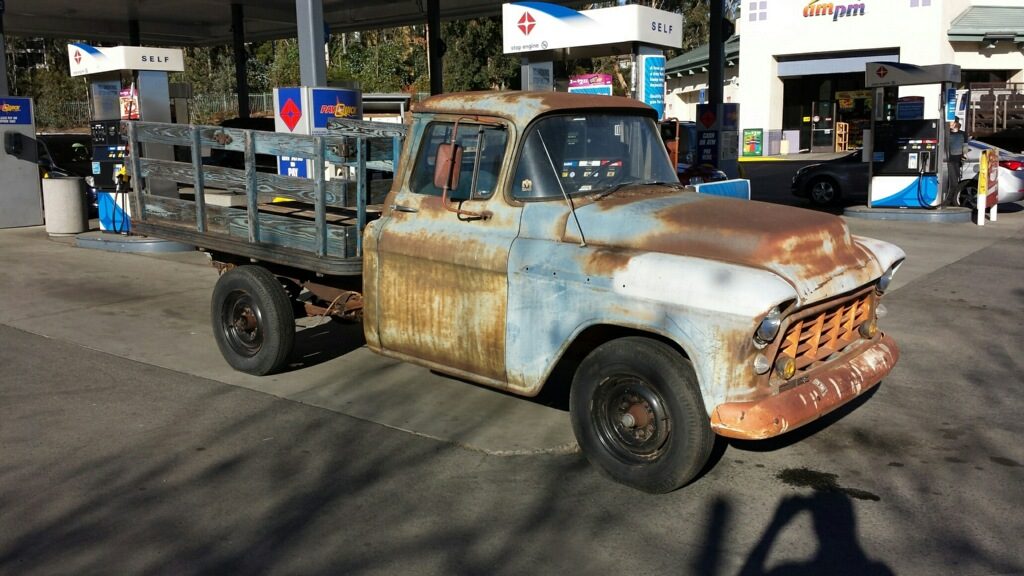
Despite the way it looks, the Fleetside is relatively rust-free. It is also minus engine and trans, and interior, and gauges, and, and, and. So, it really is a clean slate. Our goal is to make it go fast, stop fast, and get around the bends confidently.
As it stands, we will probably continue with our theme song: carbureted small block Chevy, simplicity, safety, and creative problem solving. Stay tuned as we get ready to initiate the build.
When we picked it up the truck would barely run as the carb was spewing fuel through the throttle shaft. During the test drive the previous owner almost slid the thing through a stop sign into cross traffic because only one of the drum brakes seemed to be doing its job. And the god awful bench seats smelled like an open sewer. On top of that, the left front corner of the cab was low due to a rust problem where it mounted to the frame.
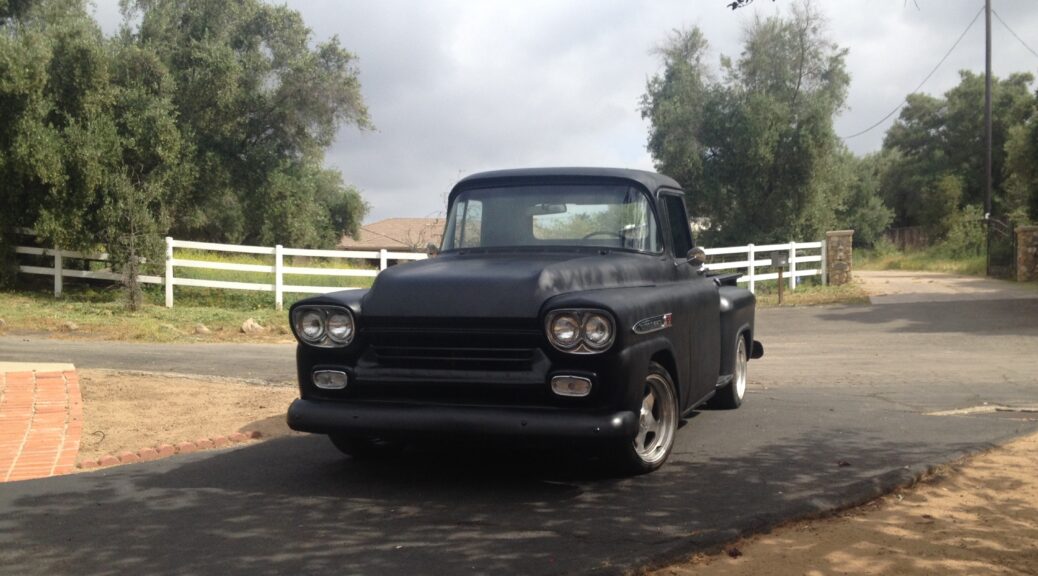
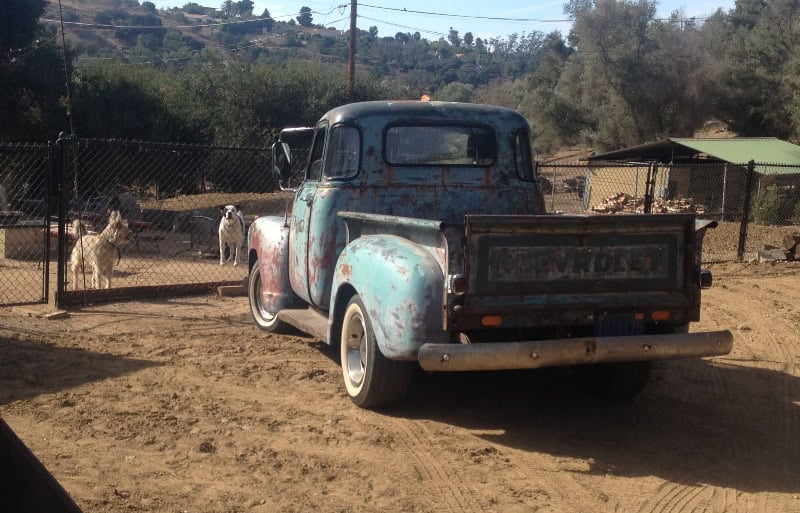
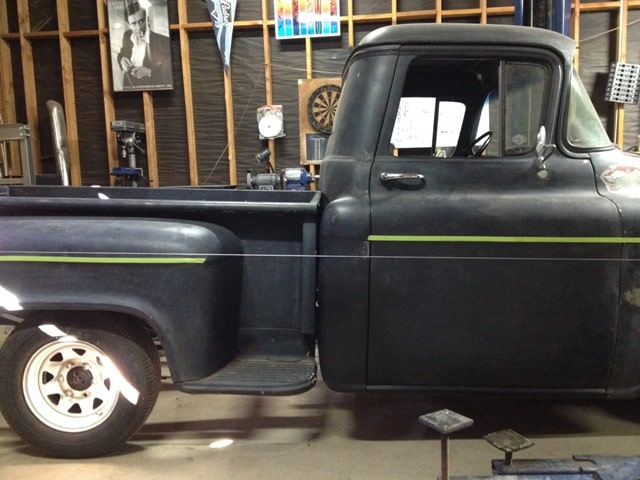
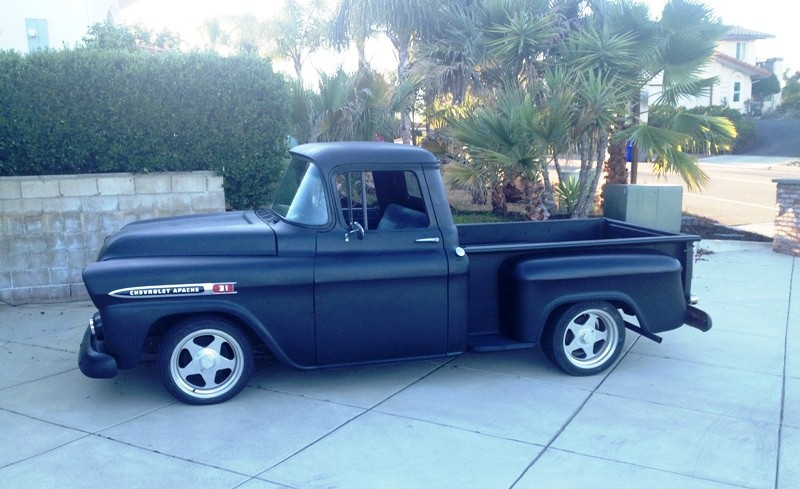
The Apache is finally back on the road with a fresh coat of satin black paint, a freshened 350 engine, and a long list of fixes and improvements. There is still plenty to do, but it is now a fun driver (and work truck – this Apache can haul!)
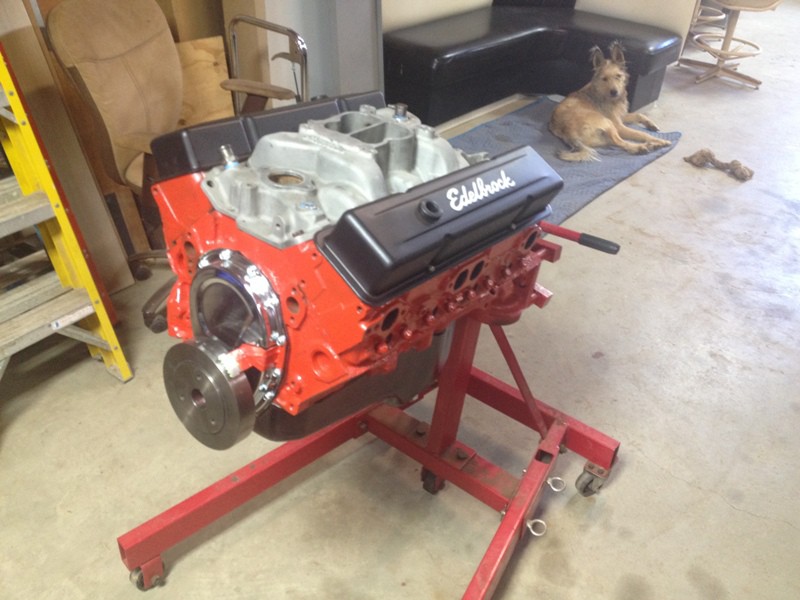
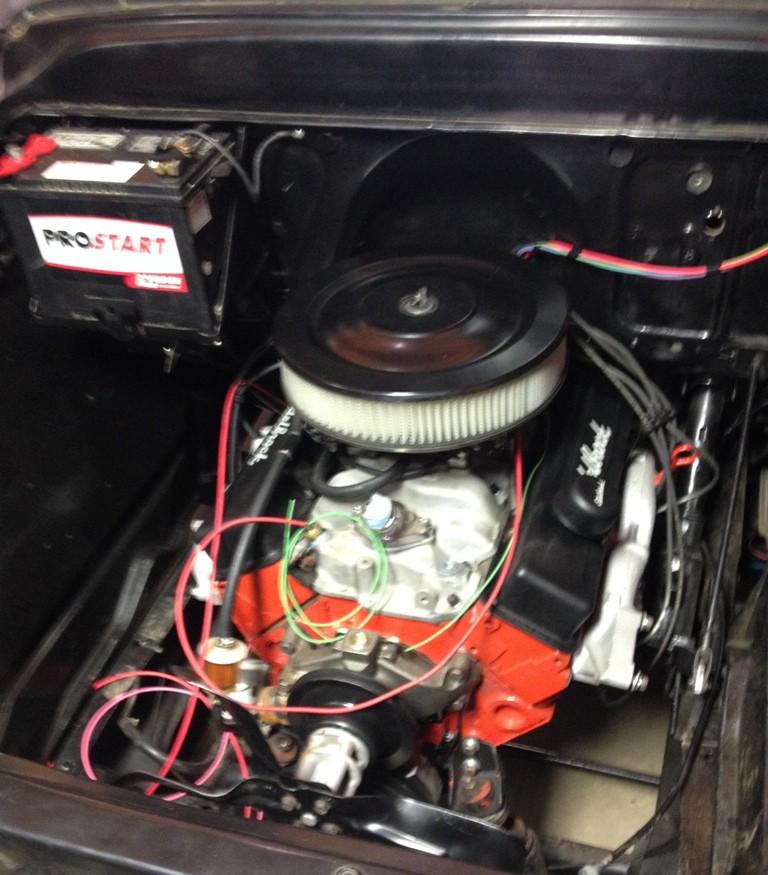
Heart of the 1959 Apache, the fresh 350 engine… check the rebuild article posted previously.
We shored up the front cab corners with 1/4 inch steel, rebuilt the drum brake system, added new shocks all around, installed a drop axle at the front, and lowered the rear to match it by re-curving the main leaf spring and removing the supplementary extra stack of leaf springs. We replaced the rear cab corners and then spent weeks cleaning up the body and chassis and prepping for paint.
Using string and tape to line up the bed with the cab prior to mounting on the frame.
The colors lurking under that old black paint.
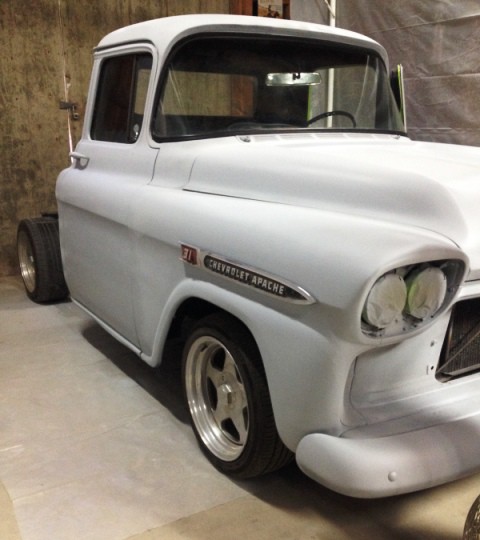
Checking out the fender emblem and Boyd’s 17 inch rims against the light gray primer. Next truck might be light gray!
At this stage, we have stuck with manual 4-speed Saginaw transmission, manual steering, and the drum brakes sans power assist. However, having just added CPP’s easily installed power steering and power assist brake kits to the ’56 “Farm Truck,” these improvements might soon appear on the Apache.
The rear end is a bit noisy, but we’re living with it for now, until the Farm Truck is finished and on the road. At this point, it’s just time to enjoy driving the big hunk of steel. The rake of the chassis, with the front end low, and the 3.90 ratio rear end make it feel sporty on the twisty roads between home and shop.
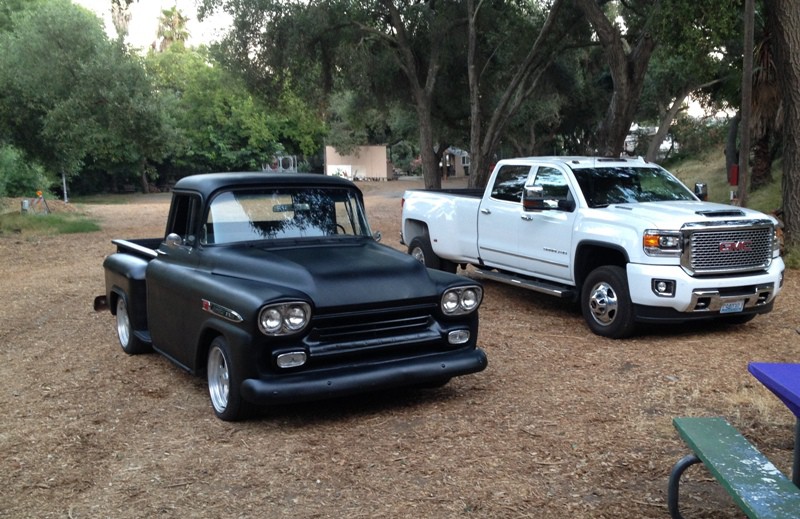
The ’59 Apache looks like a compact truck next to bro’s GMC hauler… it does haul with 900+ lbs of torque.
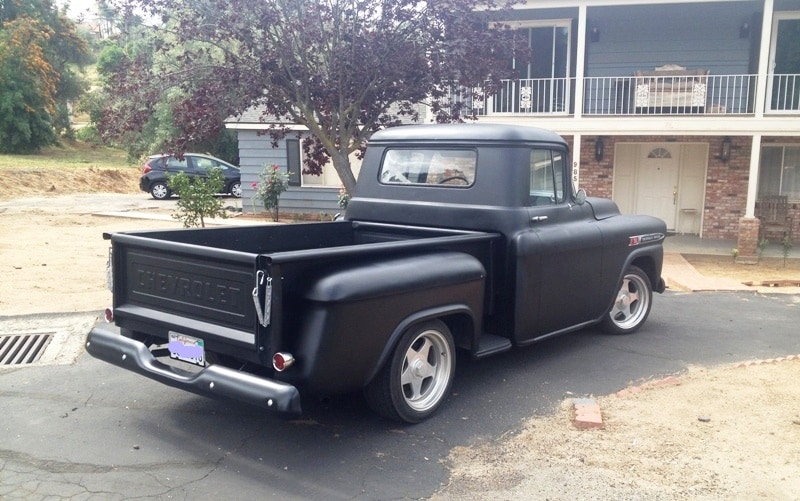
New tailgate and a little bright stuff at the rear.
The Apache ready for a cruise.
The Barn’s “first truck” isn’t a show stopper, nor is it completed to our satisfaction yet. On the other hand, our key phrase for the Apache during the build was “next guy.” So maybe it will just change hands as is, but more likely it will stay at The Barn and get more TLC right here.
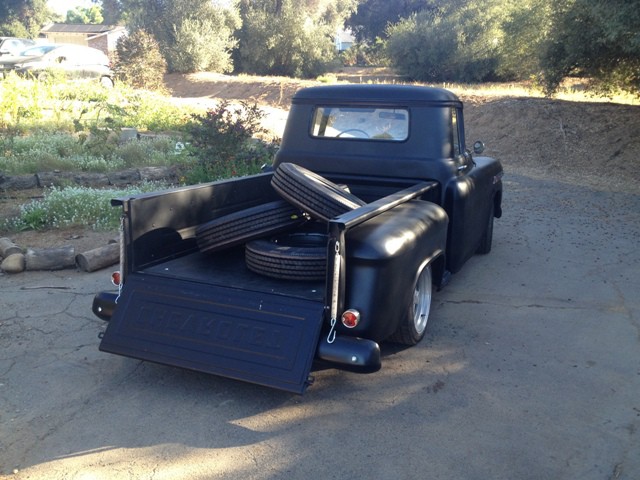
The Apache hauls… new 17.5 radials for the ’56 Farm Truck.
Why a post about bump steer? Well, because we’ve built two trucks and both suffered from horrendous bump steer problems. One was brought on by the installation of a drop axle, and the other by upgrading to later GM power steering setup.
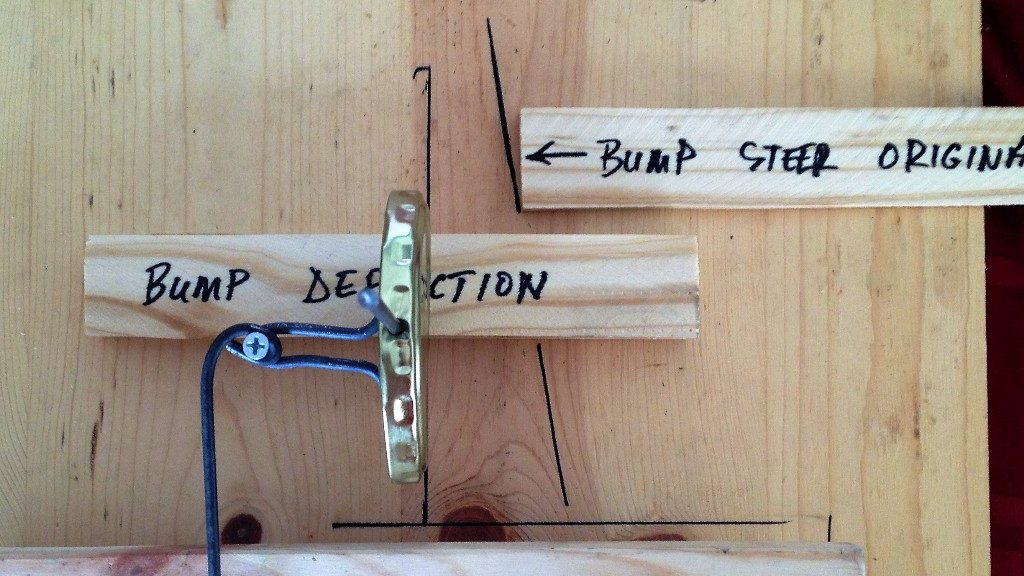
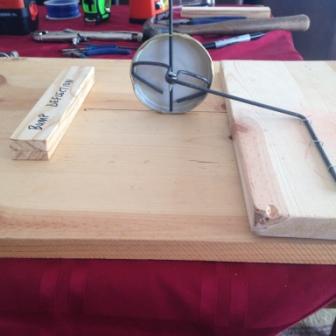
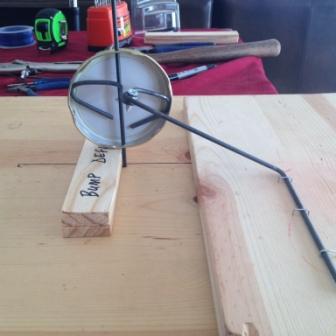
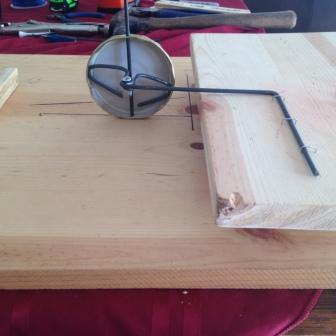
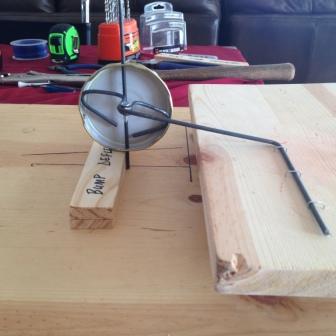
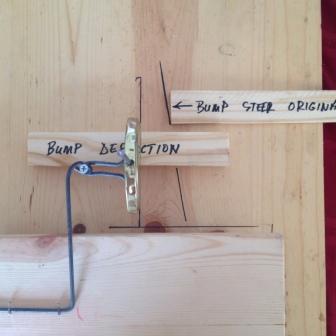
How to make it livable? You need to get the drag link parallel with the ground. A short drag link that is steeply inclined could see you bouncing into a ditch or into the oncoming lane. Not knowing how significant the effect might be, I built a simple model.
If you start with a steeply inclined drag link,
and hit a bump,
you get a lot of steering effect.
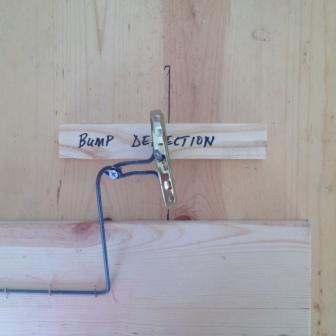
If you start with a more level drag link,
and you hit the same bump,
you get negligible bump steer. Compare to the original bump steer line.
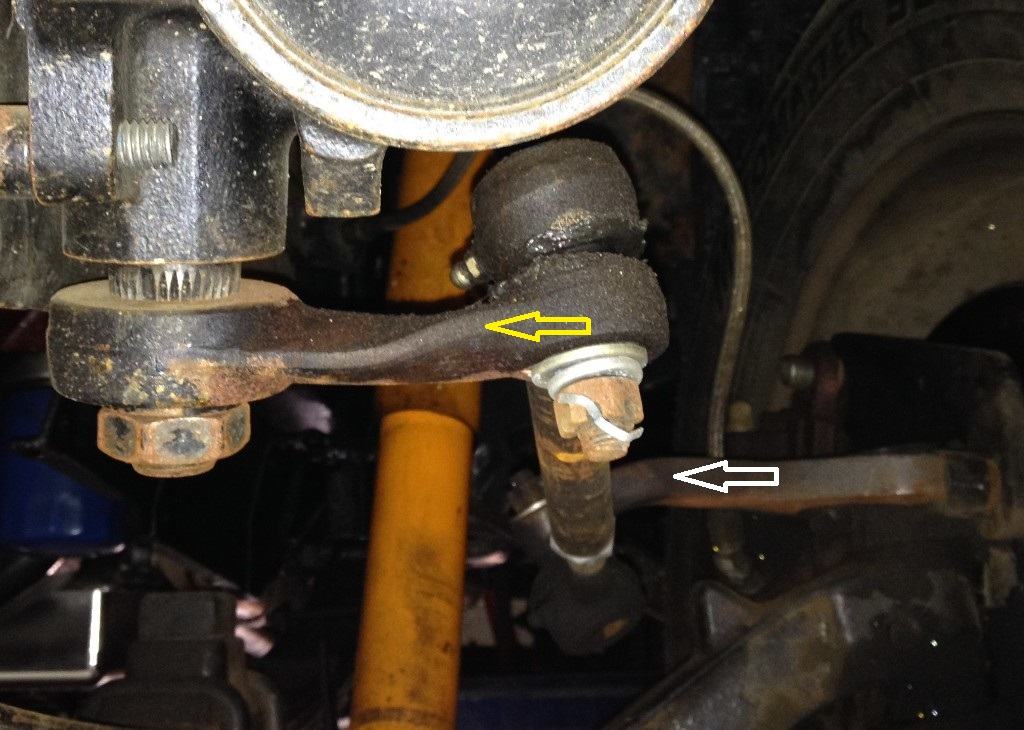
The ’48 Chevy had a CPP kit which facilitates an upgrade to a 1967-89 Chevy truck power steering setup . This entails mounting the steering box to the outside of the frame rail. CPP sells a Pitman arm for lowered trucks that allows the drag link to be dropped in from above the Pitman arm. In addition, we fired up the oxy-acetylene torch and bent the both the Pitman arm (yellow arrow) and the steering arm (white arrow) to achieve a horizontal drag link when the car was sitting on the ground. This picture was taken with the ’48 on the lift so the drag link is at a slight angle in this photo. It took a couple tries, but we finally made the steering manageable.
The twist in the Pitman arm is to prevent binding at extreme bump or extension angles.
Since this truck has significant body roll, especially at the front end, at some point we will source an anti-roll bar. (We hope) that will further decrease the bump steer effect and make the truck a little more sporty in the corners.
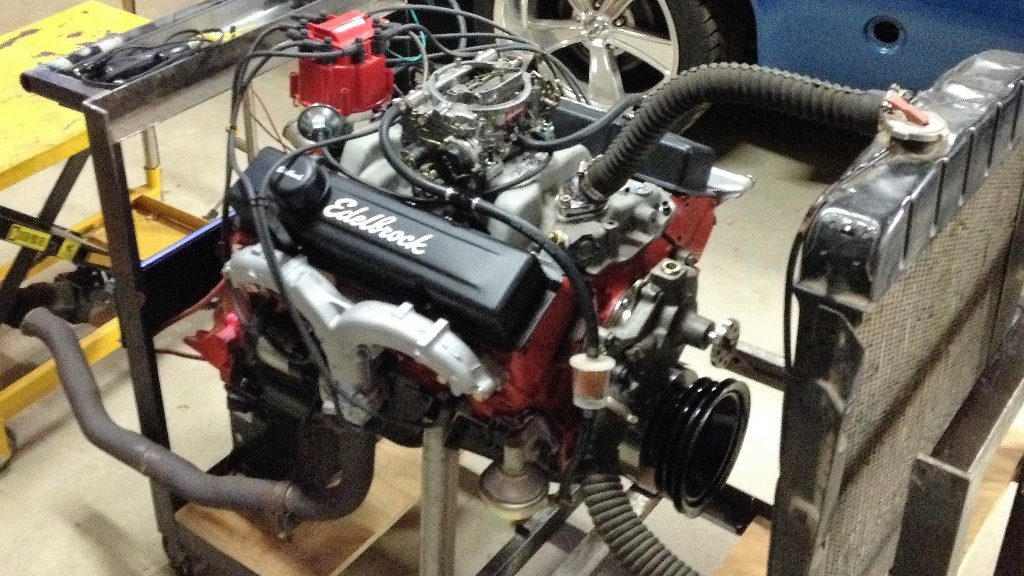
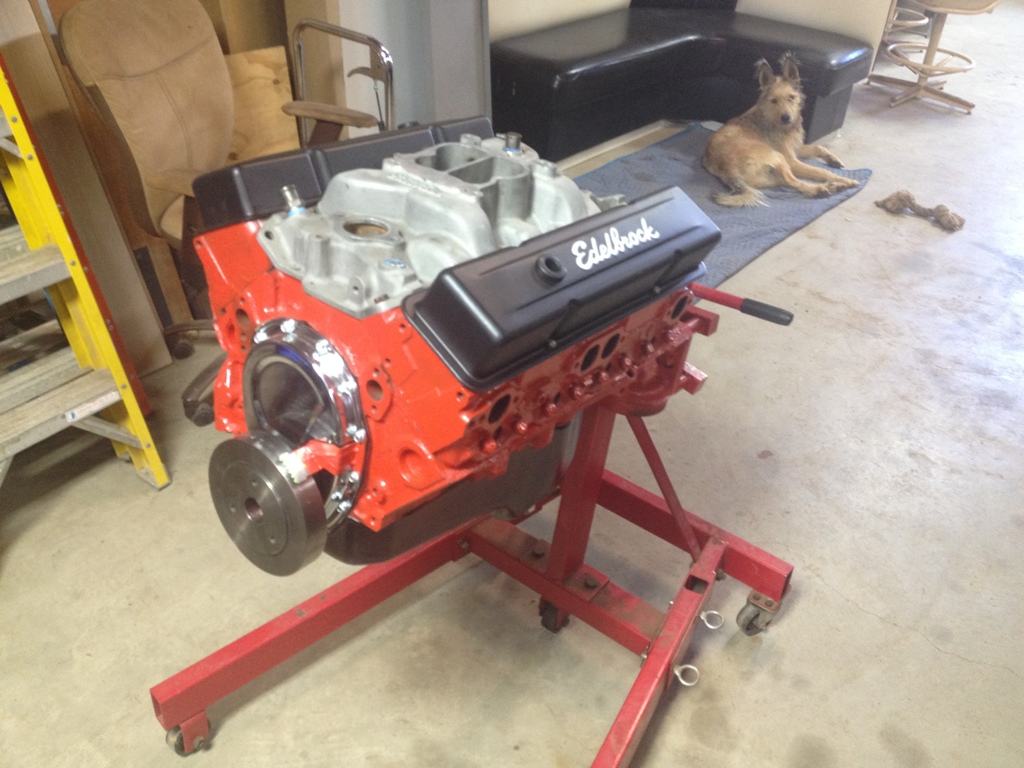
We rebuilt the 350 for the ’59 Apache, including: main and rod bearings; rings; camshaft; lifters; pushrods; oil pump; fuel pump; water pump; harmonic balancer; Edelbrock Performer manifold; Edelbrock 1406 carburetor; small chamber heads; timing chain set; valve covers; oil pan; and new freeze plugs and gaskets.
An important part of the rebuild was knocking out all the water jacket plugs (aka freeze plugs) and using our high pressure washer and compressed air to remove the chunks of rusty metal that are detrimental to cooling efficiency.
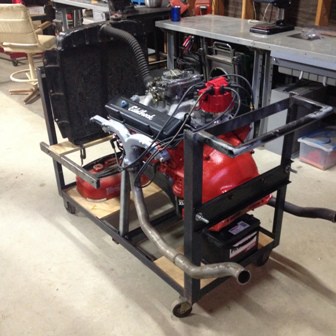
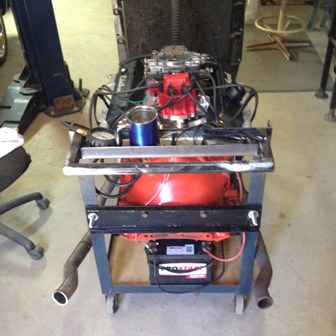
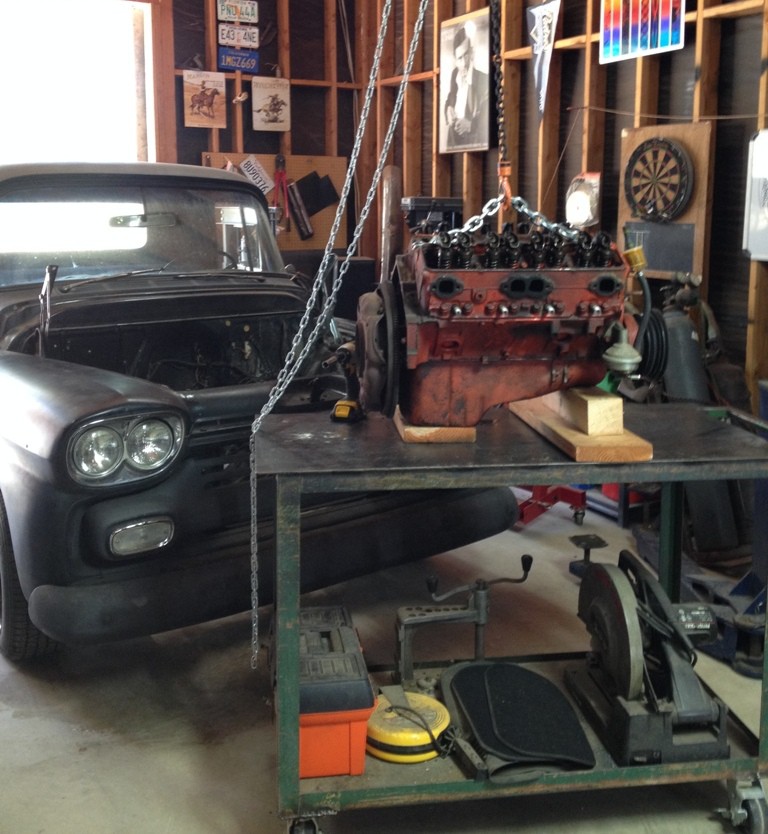
After putting it all together, there was no way I was going to stick it back in the truck without testing it first. We happened to have two heavy duty metal tables, one with a metal top that serves as our welding table. The other had a wood top and it became the temporary engine test bed. A little surgery removed the angle iron on which the wood top rested, allowing us to drop an engine into the middle. Here’s what it looked like…
Keeping it simple.
Adding the necessities.
The most important (only) gauge… oil pressure.
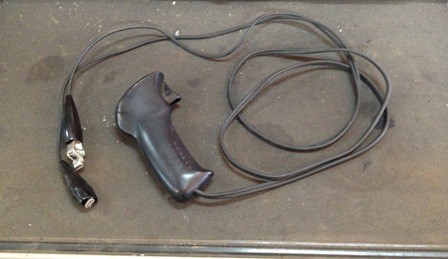
Have starter button, will travel.
Ready to go. On/off toggle in the tray, which holds gauge, pistol-grip starter button, and coffee. Might have been whiskey.
And it’s a table again, waiting for next rebuild. Bolt-in rails along the side replaced the welded originals, so the wood top is still supported lengthwise.
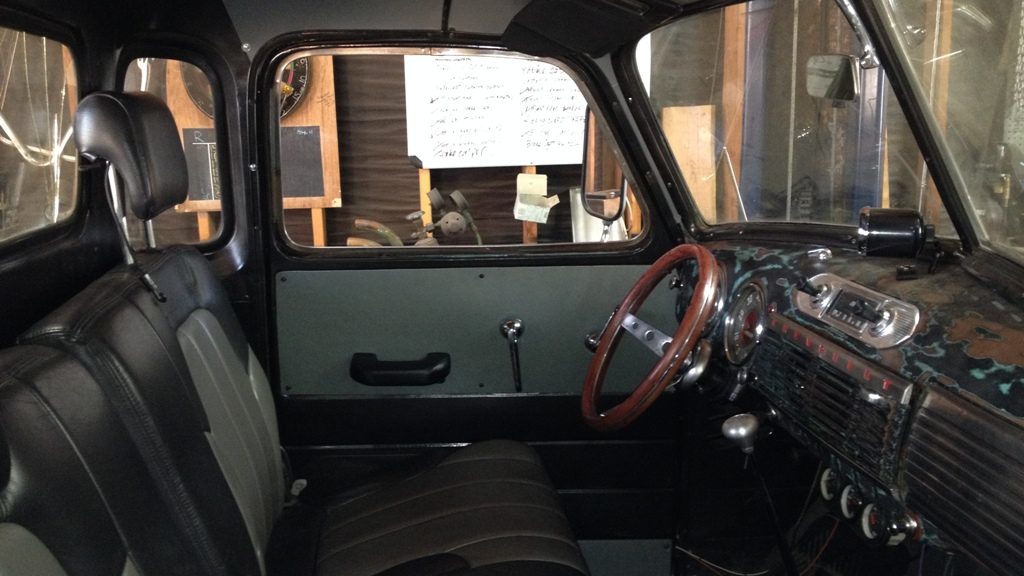
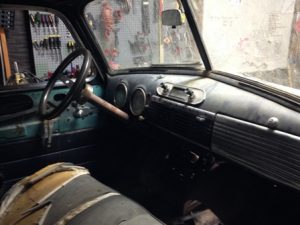
Sometimes you just get lucky. As you can see below, the interior of the ’48 was destined for the trash bin. So, after taking some measurements we headed for local wrecking yards to see what we could find. We knew we were looking for gray leather, so armed with measuring tape and a few tools, we started our hunt.
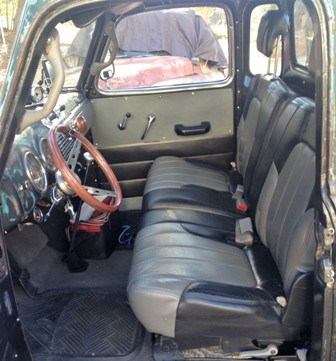
Our first stop was a yard in Oceanside where you pay a couple bucks to enter, and pull the parts yourself. As we neared the end of our walk-through, a relatively pristine 2002 Pontiac Aztek was dropped off. Eureka! Everything about the second row seat shouted “take me home.” Dimensions – check; color – check. And the seat was removed by simply pulling up on a release bar at the front. Best of all… the price: we took it home for less than fifty bucks!
The original seats would have cost a small fortune to repair.
Aztek split bench seat installed in the ’48.
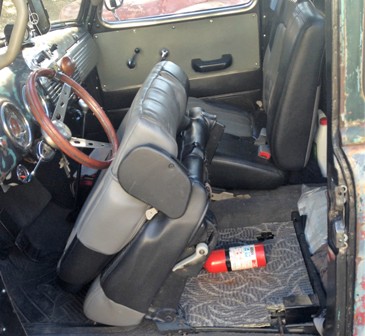
The back folds down.
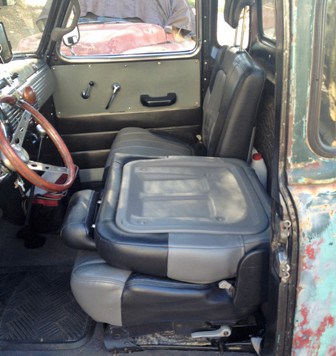
Another lever lets you tilt the seat forward.
By just pulling up on a bar at the front of the seat, the entire assembly lifts out of the truck. A good find for a grand total of $47.50 plus our time to install in the truck. The Pontiac Azteks weren’t pretty, but they are interesting cars, especially with camping accessories.
So, we bought the ’59 Apache. Generally, we knew what we were getting, but what exactly did we buy? Time for a little detective work.
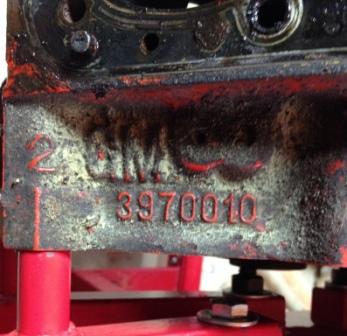
It has a 350 small block Chevy engine. The number at the rear of the block on the driver side tells us that this is a 3970010 block casting, which had a ten year run, from 1969 to 1979, and was used for 302 and 350 cubic inch engines.
Rear of block, driver’s side.
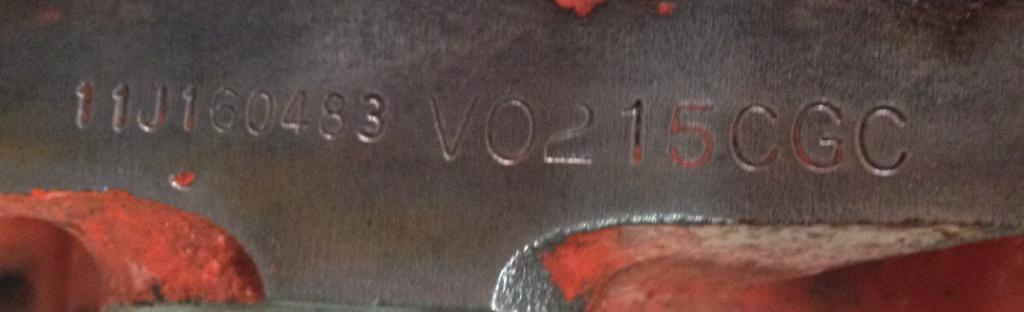
To get a little more specific information, we looked for the engine’s three letter suffix, in our case “CGC,” found on the passenger side of the engine just below the cylinder head at the front. Turns out our engine was 350 from 1971 with 245 hp. It would have been installed in an El Camino with the turbo-hydramatic, or a full-size manual transmission car, police car, or taxi.
Front of block, passenger side.
The “11J” at the beginning indicates the car was a Chevrolet, model year 1971, built at GM’s oldest assembly plant in Janesville, Wisconsin (set up in 1919, and shuttered in 2009). The beginning of the engine code “V0215” indicates the engine build was at the Flint plant on February 15th.
Under the valve cover.
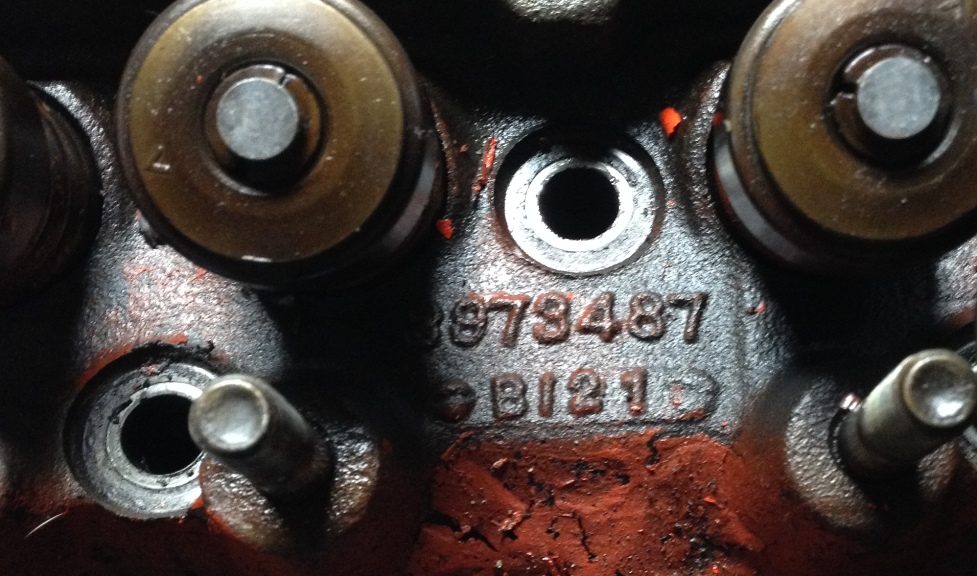
Removing the valve covers revealed the cylinder head identifying numbers “3973487” which indicates that this is a “smog” head with 1.94 intake / 1.50 exhaust valve diameters. Not a good base for making power because of the size (76 cc) and shape of the combustion chambers. We ended up swapping these heads for ones with a 58 cc combustion chamber, just to put a little more pop in the explosion… more on that in a future post about the engine rebuild.
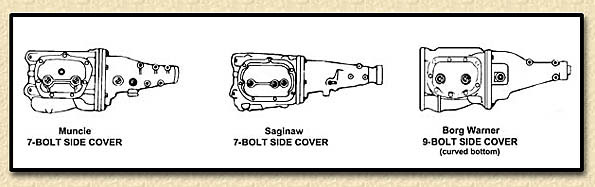
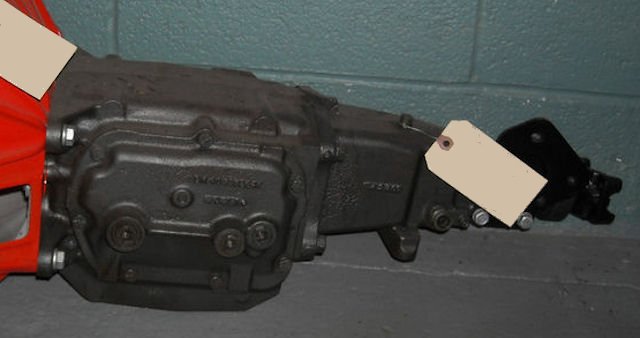
It was easy to identify the transmission as a Saginaw. These manual gearboxes have seven bolts fastening the side cover and all three shift levers are on the side cover. The Muncie also has seven bolts securing the side cover but the reverse shift lever is on the tail housing.
photo from http://chevellestuff.net/qd/muncie.htm
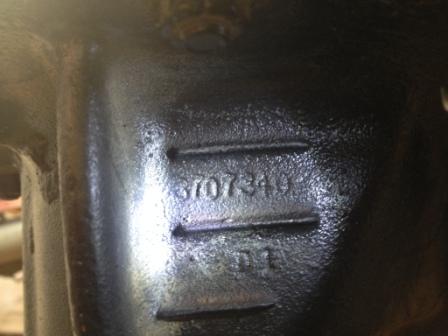
The final piece of the drivetrain – the differential – yielded its specifications, as well, once we were able to guess correctly at the last digit of the casting number.
A Google search on GM differential 3707340 pointed us to a number of gear vendors. They revealed the same information…
GM ’55 – ’64 1/2 ton truck
drop out carrier
10 bolt rear cover
c/clip axles
12 ring gear bolts (3/8 x 24)
ring gear diameter: 9.375″
pinion nut size 1 – 1/8th”
Yukon Gear, Randy’s Worldwide, and Sierra Gear all list a GM55T-338 replacement ring and pinion with a 3.38 to 1 ratio along with all the other parts necessary for a rebuild. I would choose that ratio over the Apache’s, which seems to be a 3.90 ratio. In fact, I’d like to go even further via an overdrive transmission. If I could find a three-speed Saginaw with overdrive – for a reasonable price – I would swap it for the four speed in a heartbeat.
But first things first. Unfortunately, the Apache’s rear end is making the worn-ring-and-pinion howl and that means I need to put it on the bench for inspection and adjustment or replacement.
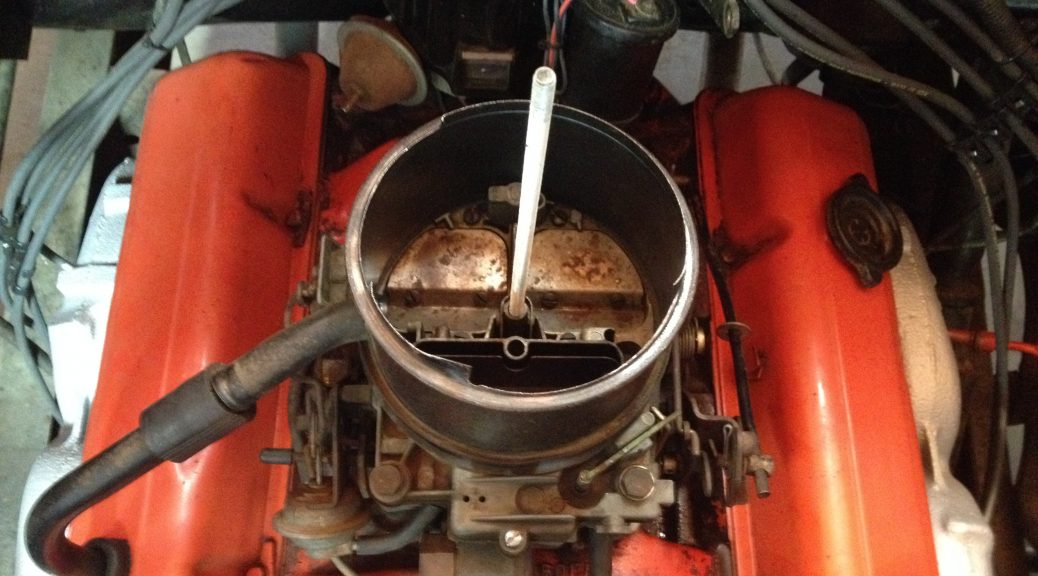
From the day we bought the Apache, it needed an engine rebuild. Perhaps the biggest factor in its poor-running was the Rochester Quadrajet carburetor. I know they are a fine when in good condition, but this one was well past its “use by” date. It was in need of a complete rebuild or replacement.
We tolerated the crappy running motor while busying ourselves with body and interior jobs, and brakes, and steering. Until one day, this happened. The truck had been sitting for three days on a slope with the nose down. I tried to start it but the battery wasn’t strong enough to turn it over. After charging it up for half an hour, I checked the voltage and gave it another try. Still it wouldn’t turn over!
Inspecting the engine, I noticed a couple little puddles of gasoline on the intake manifold. Then the light bulb went on… I reckoned that the Q-Jet’s floats had caused the needle valve to stay open, filling the motor with gasoline. Remember, the Apache’s fuel tank sits high, inside the cab. I pulled a spark plug and found that, sure enough, the engine was locked up because the cylinders were full of premium unleaded.
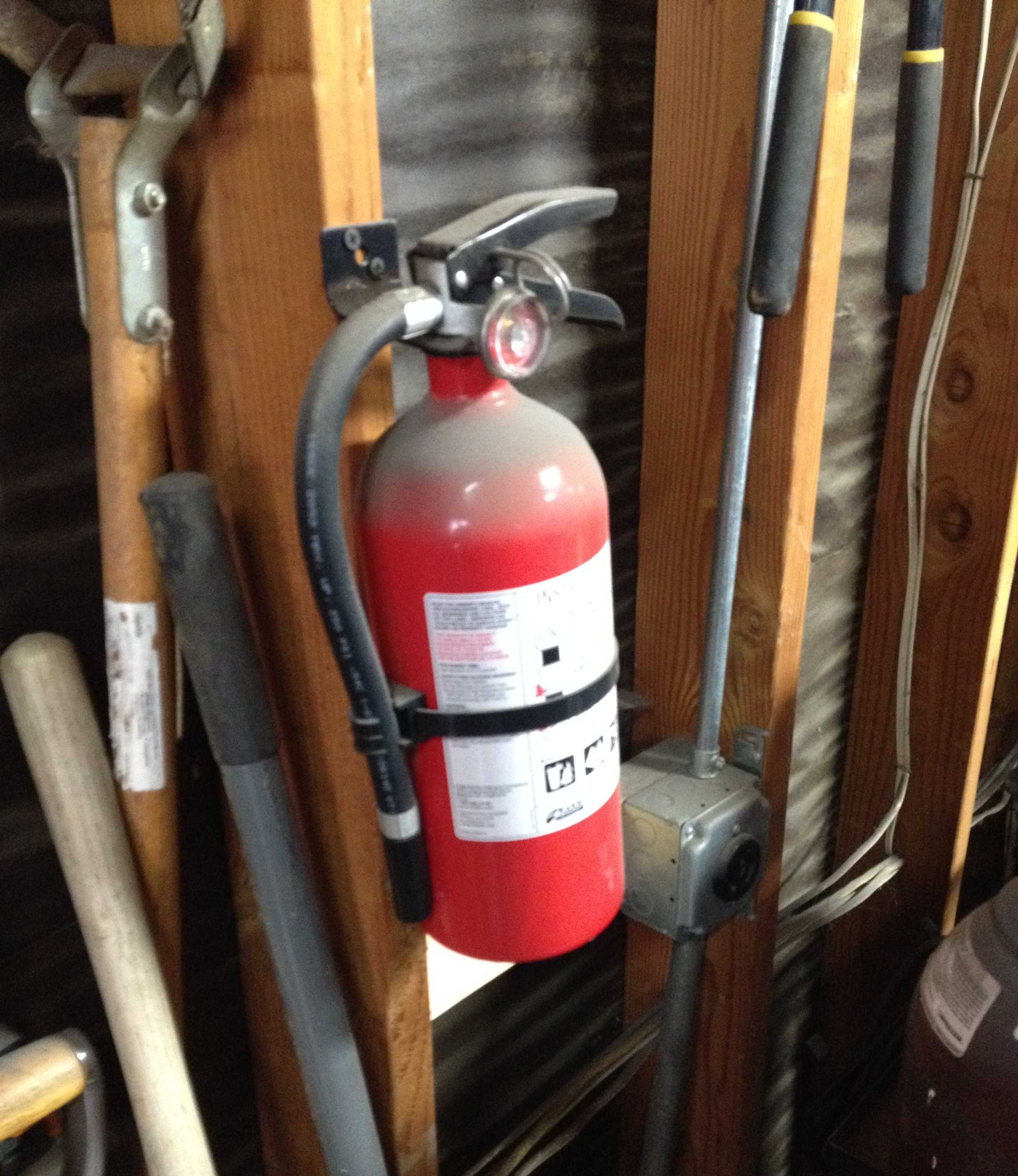
So, I removed the rest of the spark plugs and cranked over the engine, pumping the gas out of the cylinders. I’m not sure if the idea of getting started with the engine rebuild came before or after the fireball. I do know the fireball looked impressive from the driver’s seat. And Russel’s response time with the fire extinguisher was also impressive. These events provided the final impetus to get going on the rebuild, and the final nail in the coffin for the Q-jet.
p.s.: DO remember to disconnect coil wire next time.
Good idea to have two or three of these around.
I visited a couple of local machine shops specializing in engine rebuilding and estimated that I could expect to pay at least $1200 for a complete rebuild. I trusted both of these shops and knew they would deliver a solid value, and it was tempting to just load the engine into the pickup and get it back a week later ready to install.
Instead, we decided to save some bucks and have a go at the rebuild ourselves… something Russel and I had always looked forward to doing. Tallying the bills after we finished showed we spent a little less than $500 on the rebuild plus another $290 (which would have been added to the professional build, as well) for a used Edelbrock carburetor and manifold. Check out the engine rebuild article for details.
First order of business: pulling the engine. With a chain hoist strapped to the cross beam of our lift, and after first removing the Saginaw transmission, it wasn’t difficult to remove the engine without assistance.
Pause for flywheel removal.
After the engine block was stripped, the expansion plugs were removed, along with the oil gallery plugs. The only problematic ones were the three threaded oil gallery plugs at the back of the block. With these we applied penetrating oil, heat, a long breaker bar, and brute strength. In one case we needed to drill through the plug and use a bolt extractor, taking care not to damage the threads in the block.
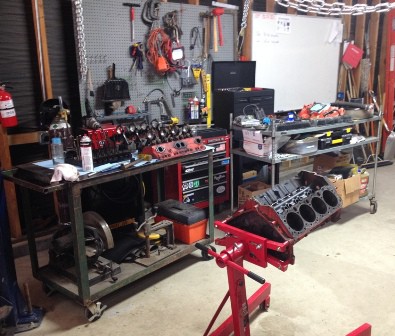
The tear down.
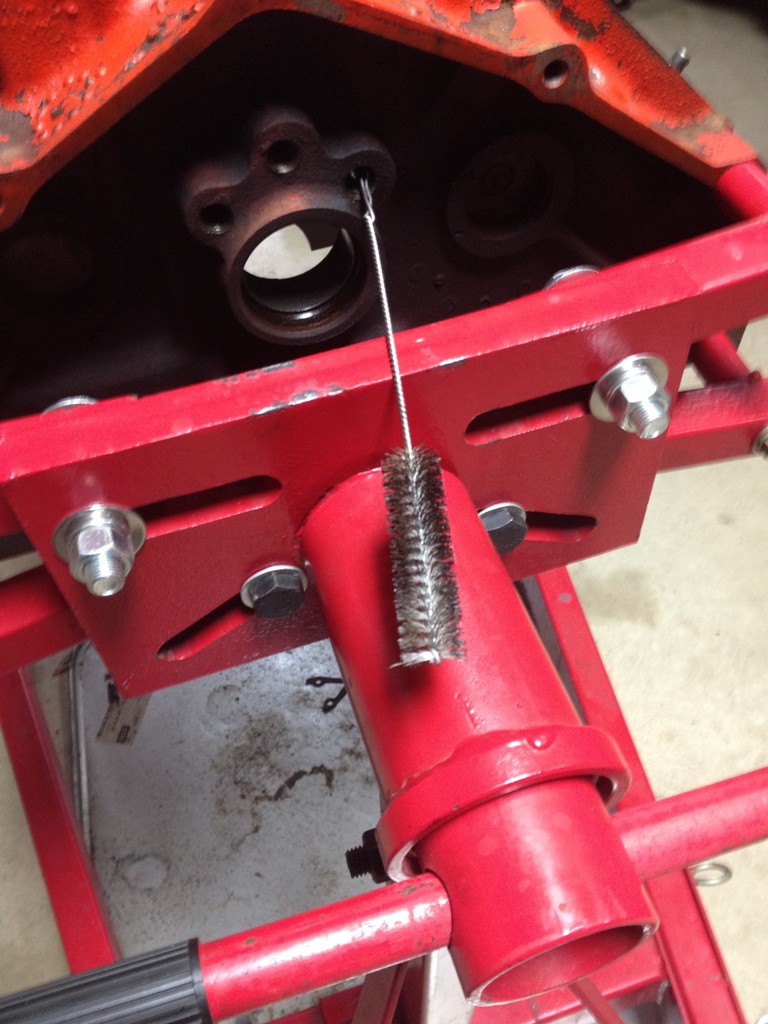
Brushes, scrapers, a pressure washer, and compressed air were used to thoroughly clean every nook and cranny of the block. This engine ran hot, and after seeing how much rusty, flaky, corroded metal we blew out of the water jackets, it was no surprise. We cleaned up every hole that was going to have a bolt threaded in, used scrapers and scouring pads on all sealing surfaces, used brushes and air in all the oil passages, and followed with more pressure washing. WD-40 was used to prevent the cylinders and bearing journals from rusting.
Clean everything… three times!
After the tedious job of measuring the cylinder bores at the bottom, middle, and top in two perpendicular directions (with a telescoping gauge and caliper), we were satisfied that we could just hone the cylinders and install new rings on the old pistons. Most of the clean up was done with a 240 grit rigid hone, but to produce a better cross-hatch we switched to a flex-hone to finish the cylinders. A final wash with water and a cylinder brush, followed by another coat of WD-40, and the cylinder work was checked off.
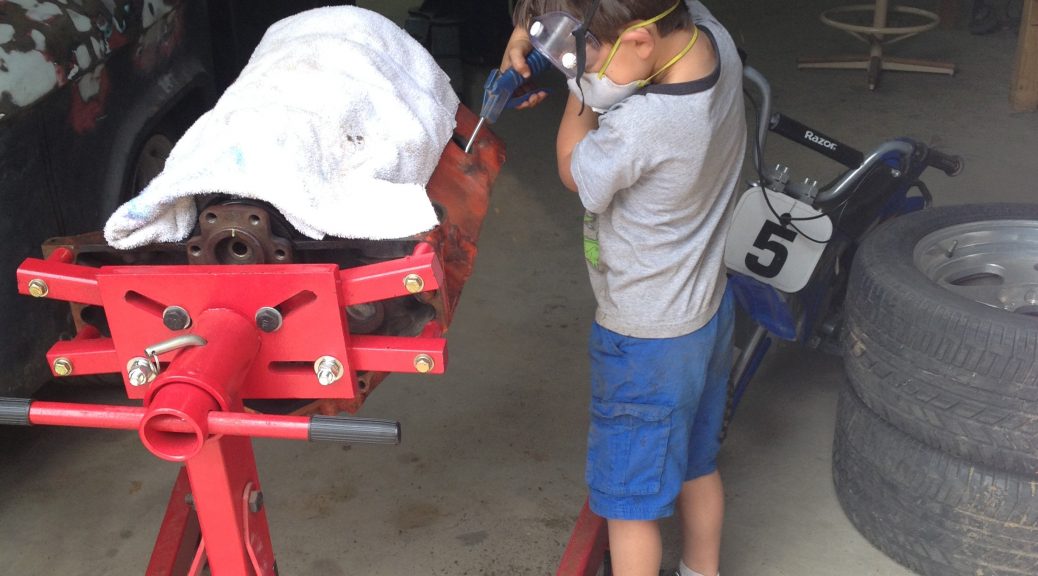
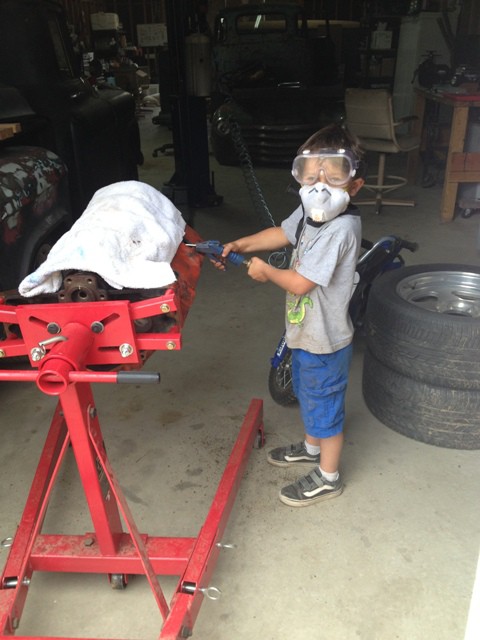
Our junior mechanic, Tommy, blowing out the water jackets.
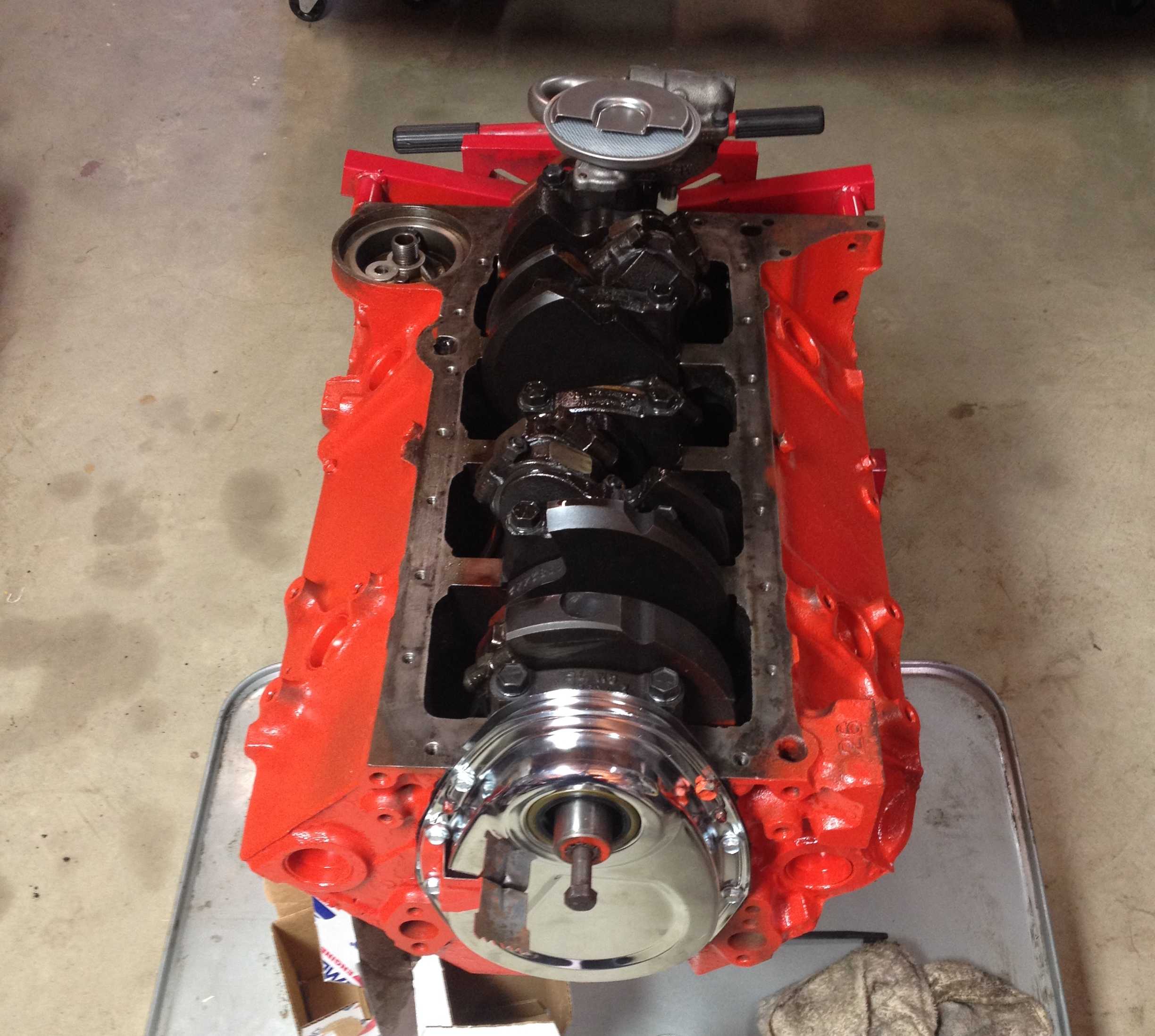
The crankshaft journals were cleaned up with 2000 grit sandpaper, cut into strips. We used our telescoping gauge, caliper, and micrometer to determine which bearing shells to order. Then we picked up some plastigage at the parts store, and installed the caps to the recommended torque to confirm that our new (standard size) main bearings and rod bearings were within spec.
We had purchased a $32 camshaft bearing tool and used it to remove the old and install the new cam bearings. Then we slid the new 1103 camshaft from Summit Racing (slightly more aggressive than the stock camshaft), new lifters, pushrods, rocker arms, gaskets, and valve covers. We decided to put the 487 heads on the shelf for future fun (porting practice), and instead used the 624 heads that we had in the barn. These particular heads have smaller combustion chambers (58 cc versus 76 cc) and valves, but the main motivation was that they were ready to install.
Bottom end coming together.
We felt the reduced valve sizes didn’t matter with this truck, since we weren’t going racing with it and didn’t care about power up high in the rpm range. We do like torque. The combination of the 1103 camshaft, the increase in compression ratio, the Edelbrock 1406 carburetor on a Performer manifold, plus new rings sealing the pistons in our freshly honed cylinders resulted in a very nice motor for the Apache.
The rebuild included a new oil pump, fuel pump, water pump, oil pan, spark plugs and wires, harmonic balancer, timing chain set, timing chain cover, and gaskets. We purchased an HEI distributor, but then decided we didn’t want to tear up the carpet and tunnel to accommodate the bigger cap. We stuck with our Pertronix setup and an external coil.
Nearly there.
Excluding the Edelbrock carb and manifold, which cost us $290, the rebuild came to just under $500. Based on the estimate of $1200 for a professional rebuild – by a trusted machine shop – it amounted to quite a saving. Plus, we really wanted to rebuild an engine ourselves… the Apache was the perfect opportunity.