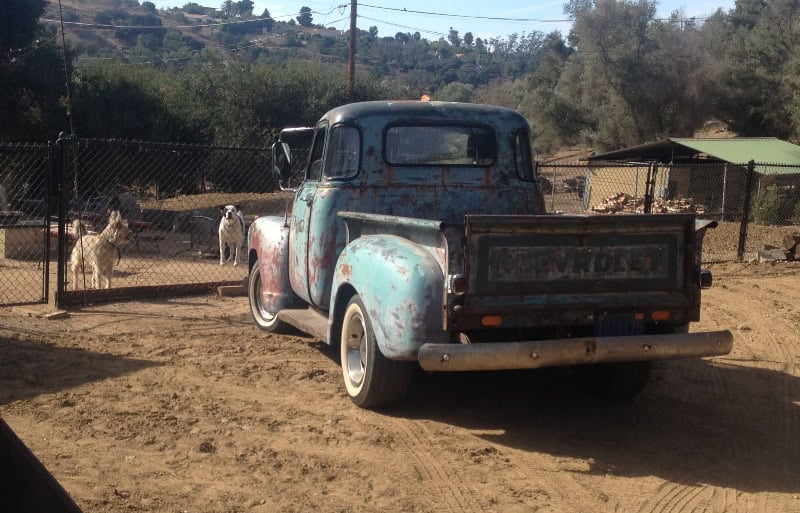
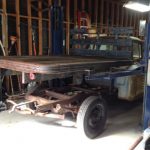
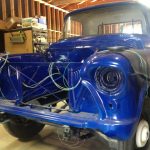
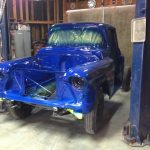
When my friend and fellow barn junkie, Lance, asked if we could get his recovered ’48 half-ton running again, I agreed. Little did we know it would take a fifteen month bite out of our schedule for the Apache. But after his truck – in his family for decades – was mistakenly sold from the private property where it was being stored, it took him quite a while to find it and reclaim it, and to convince the DMV that he wasn’t an axe-murderer. So what’s a few months in the grand scheme of things.
The reclaimed truck was minus its engine and transmission, and what remained of it was in a sorry state. Things were not looking good for this budget build until Lance found a restored ’48 chassis with a 327 small block and TH 350 transmission. The previous owner had thrown in the towel on a project started a decade earlier. The rest is history.
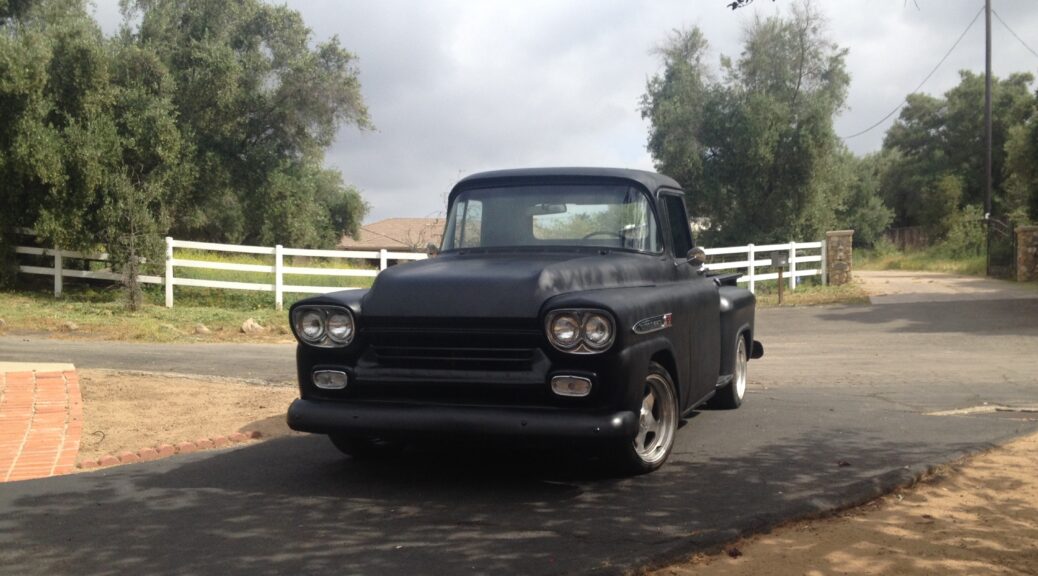
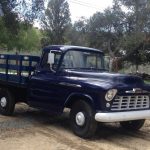
What to do when you have a big old barn with a cement floor and electricity? Go find an old truck, of course. In this case, we jumped in with both feet and ended up with a somewhat sorry 1959 Chevrolet 3100 Apache, short bed, step side, small window.
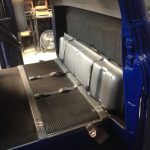
A few words about the “patient.” The truck would barely run as the carb was spewing fuel through the throttle shaft. During the test drive the previous owner almost slid the thing through a stop sign into cross traffic because only one of the drum brakes seemed to be doing its job. And the god awful bench seats smelled like an open sewer. On top of that, the left front corner of the cab was low due to a rust problem where it mounted to the frame.
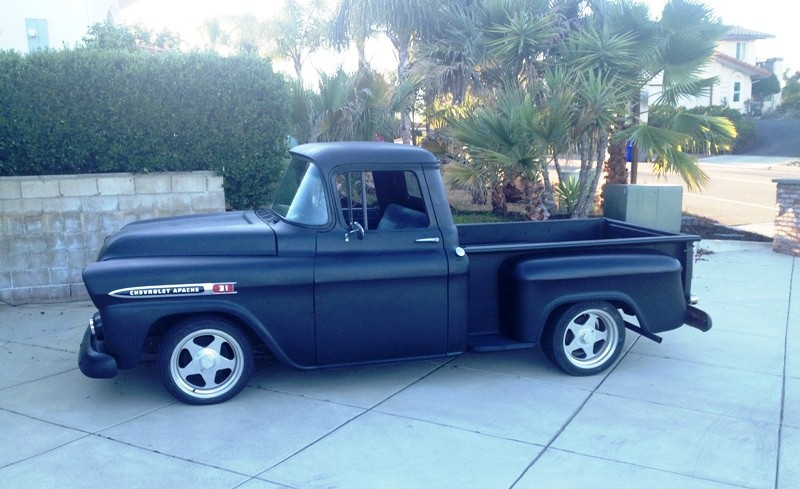
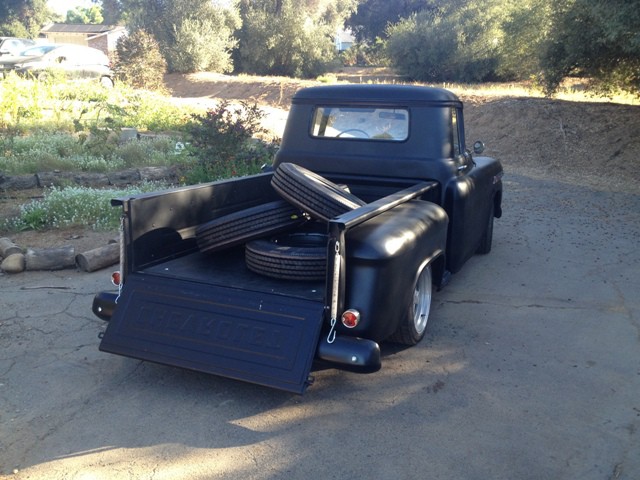
The Apache is finally back on the road with a fresh coat of satin black paint, a freshened 350 engine, and a long list of fixes and improvements. There is still plenty to do, but it is now a fun driver (and work truck – this Apache can haul!)
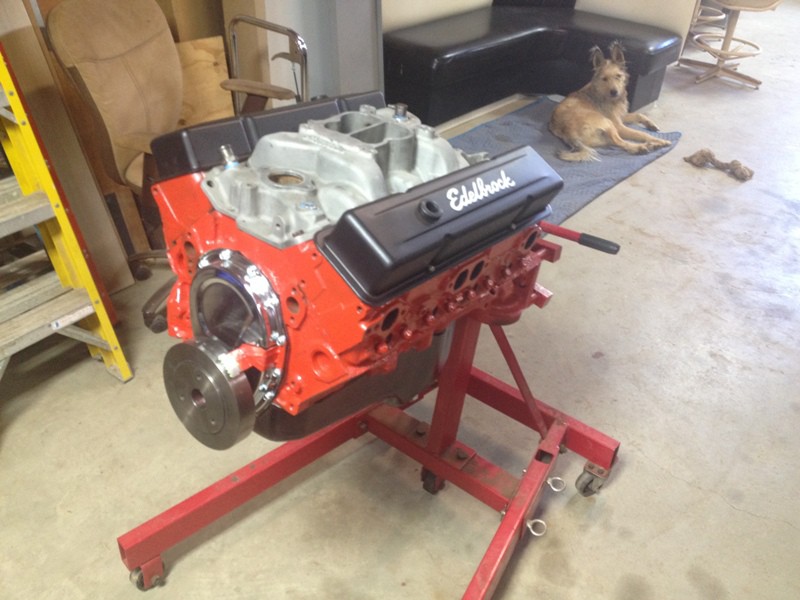
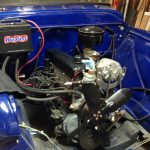
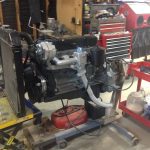
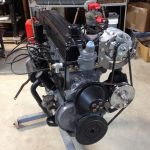
Heart of the 1959 Apache, the fresh 350 engine… check the rebuild article posted previously.
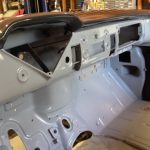
We shored up the front cab corners with 1/4 inch steel, rebuilt the drum brake system, added new shocks all around, installed a drop axle at the front, and lowered the rear to match it by re-curving the main leaf spring and removing the supplementary extra stack of leaf springs. We replaced the rear cab corners and then spent weeks cleaning up the body and chassis and prepping for paint.
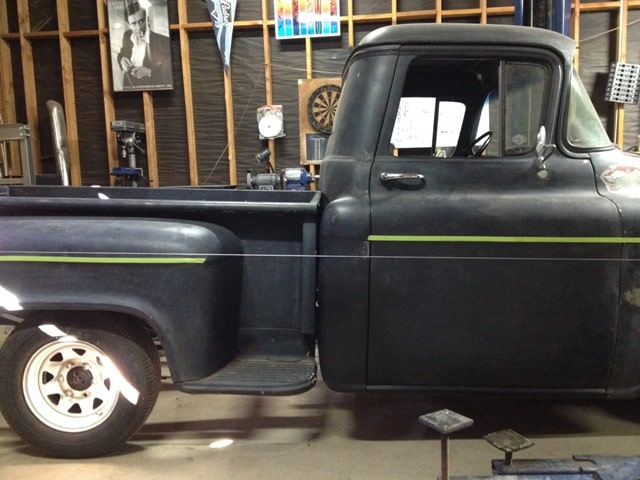
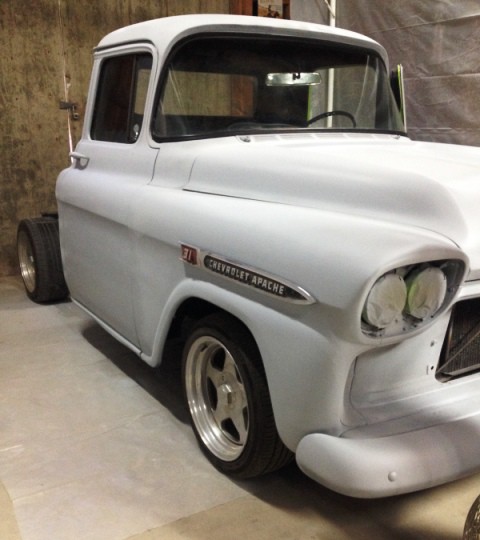
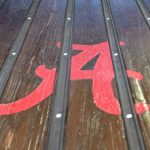
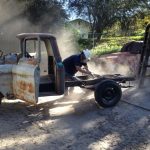
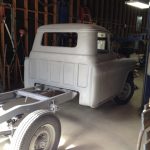
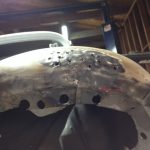
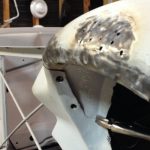
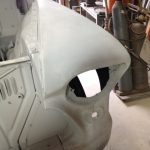
Using string and tape to line up the bed with the cab prior to mounting on the frame.The colors lurking under that old black paint.Checking out the fender emblem and Boyd’s 17 inch rims against the light gray primer. Next truck might be light gray!
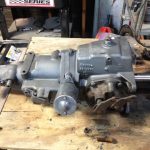
At this stage, we have stuck with manual 4-speed Saginaw transmission, manual steering, and the drum brakes sans power assist. However, having just added CPP’s easily installed power steering and power assist brake kits to the ’56 “Farm Truck,” these improvements might soon appear on the Apache.
The rear end is a bit noisy, but we’re living with it for now, until the Farm Truck is finished and on the road. At this point, it’s just time to enjoy driving the big hunk of steel. The rake of the chassis, with the front end low, and the 3.90 ratio rear end make it feel sporty on the twisty roads between home and shop.
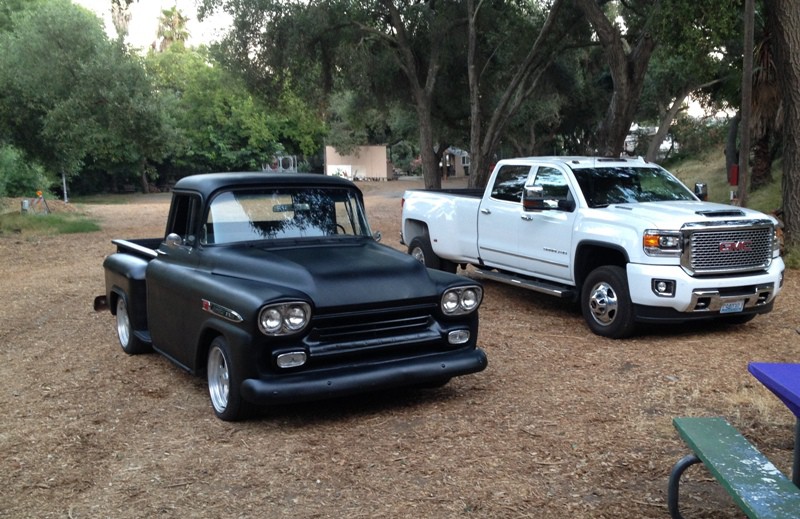
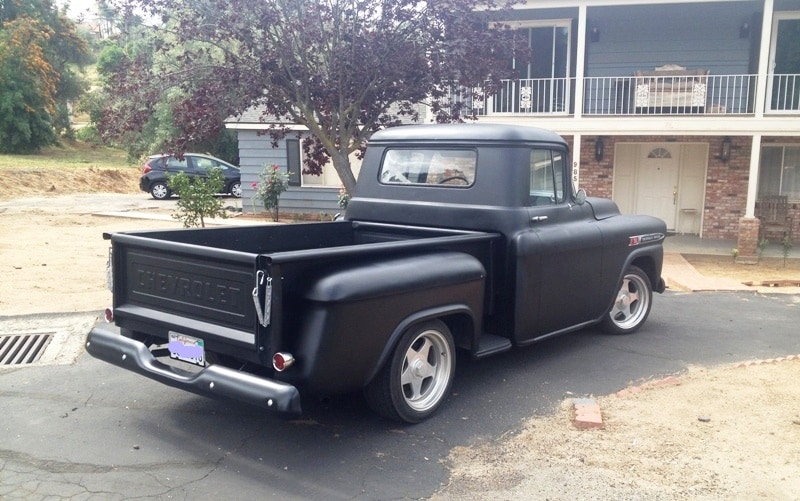
The ’59 Apache looks like a compact truck next to bro’s GMC hauler… it does haul with 900+ lbs of torque.New tailgate and a little bright stuff at the rear.The Apache ready for a cruise.
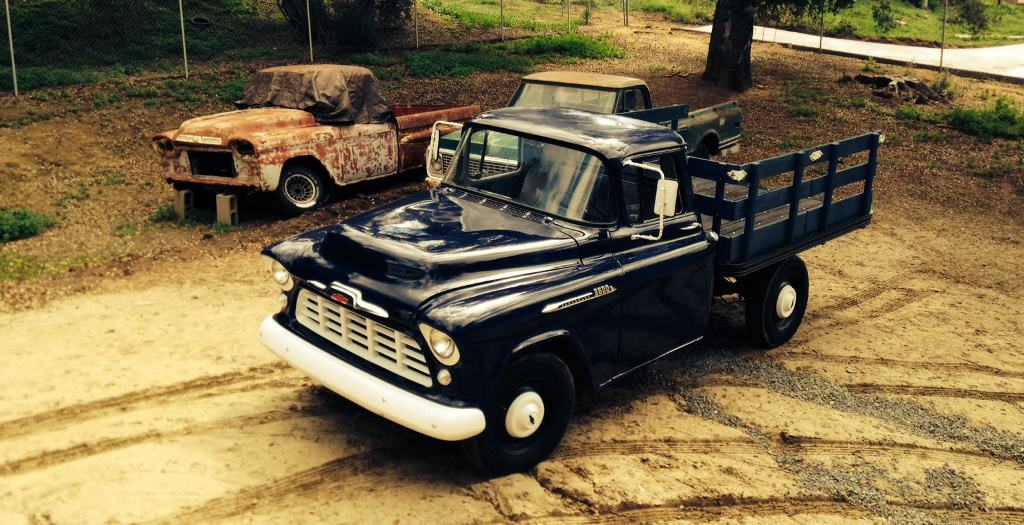
The Barn’s “first truck” isn’t a show stopper, nor is it completed to our satisfaction yet. On the other hand, our key phrase for the Apache during the build was “next guy.” So maybe it will just change hands as is, to add a little to the budget for our next project… the ’58 GMC seen behind the Apache in the title picture.
The Apache hauls… new 17.5 radials for the ’56 Farm Truck.
Finally done, here is the After gallery. Click a picture to view the carousel…
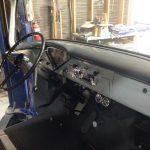
Dashboard nearly complete.
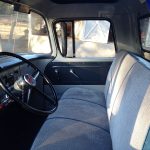
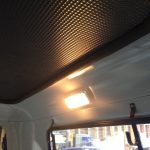
Headliner, dome light, gun rack… check!
This was the “farm truck” in January 2017, the Before gallery…
The damaged fender and the old fix, lurking under the body filler that was blasted off.
Testing it out, with blankets and towels draped on the line to dampen the snap if the line should break.
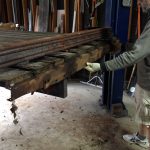
LIft off!
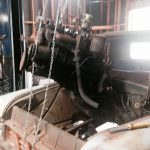
Ready for disassembly.
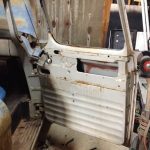
And lastly, this gallery shows some of our work. There is no question that the paint job (and prep and finish) was by far the most time consuming and at times disheartening part of the restoration. The mechanical jobs were mostly straightforward, with just a handful that caused trouble. We got pretty good at rebuilding doors and windows but a broken – yeah, we broke it – passenger side window just as we were finishing the truck gave us some grief… nobody likes to backtrack. All in all, we enjoyed the project and we’re pleased with the result.
More importantly, Lewie is happy to have the truck just as he remembered back in the sixties, but made more enjoyable with the addition of power steering, power brakes, and the overdrive transmission.
Jim Tronier at work on the frame.
Back in the barn before the next rain. Bare metal will rust if you just drop a bead of sweat on it.
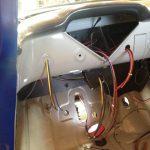
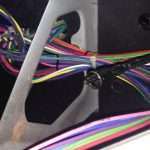
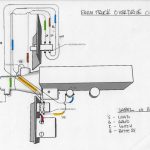
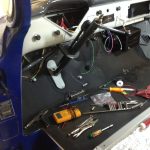
Sorting out the wiring for the dash… easy.
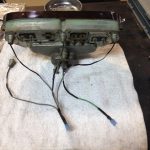
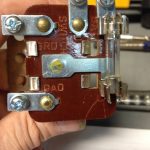
Dash lights spliced into blade connectors.
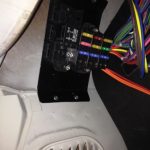
Fuse box above driver-side kick panel. Accessible but out of the way.
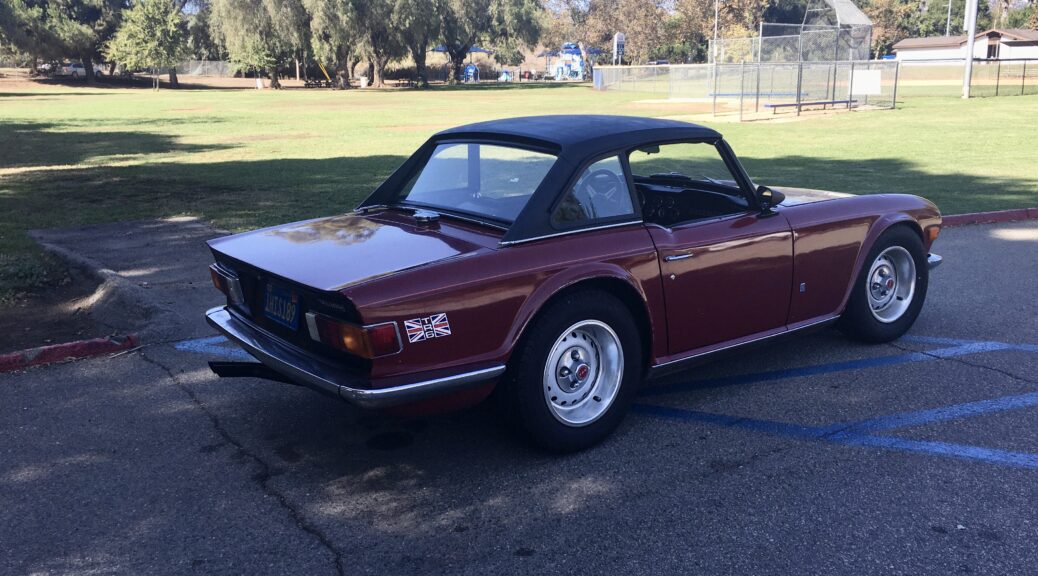
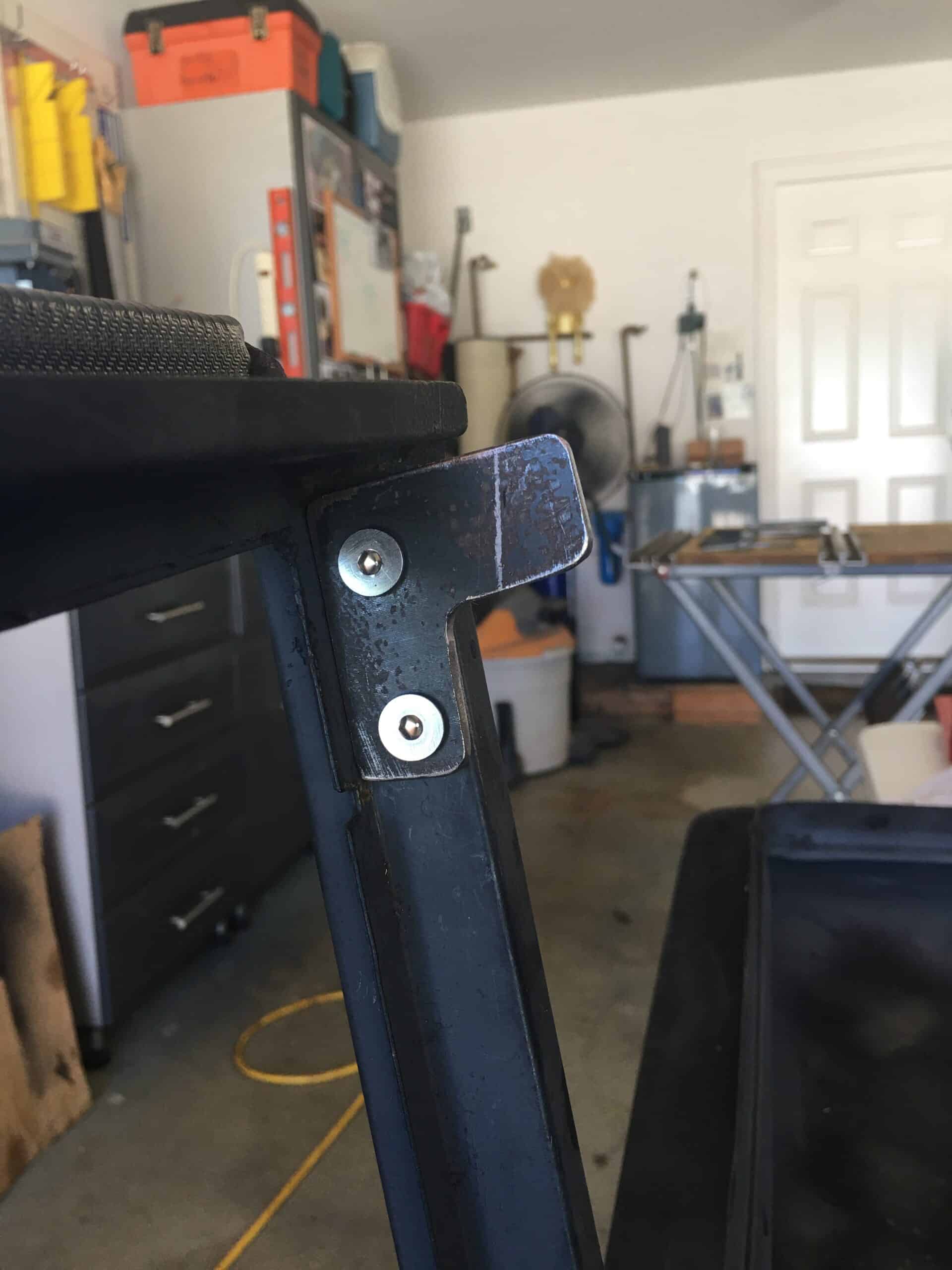
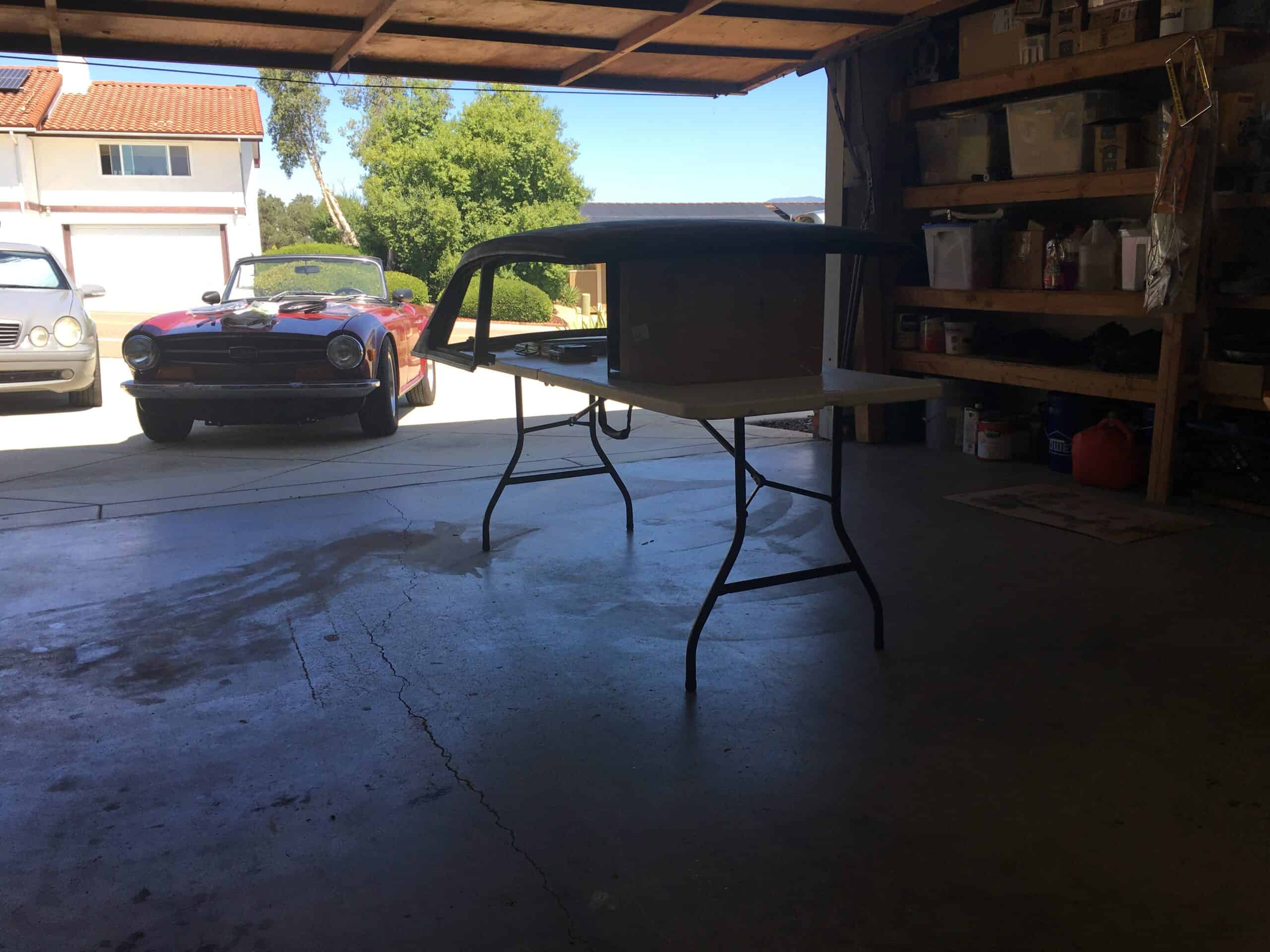
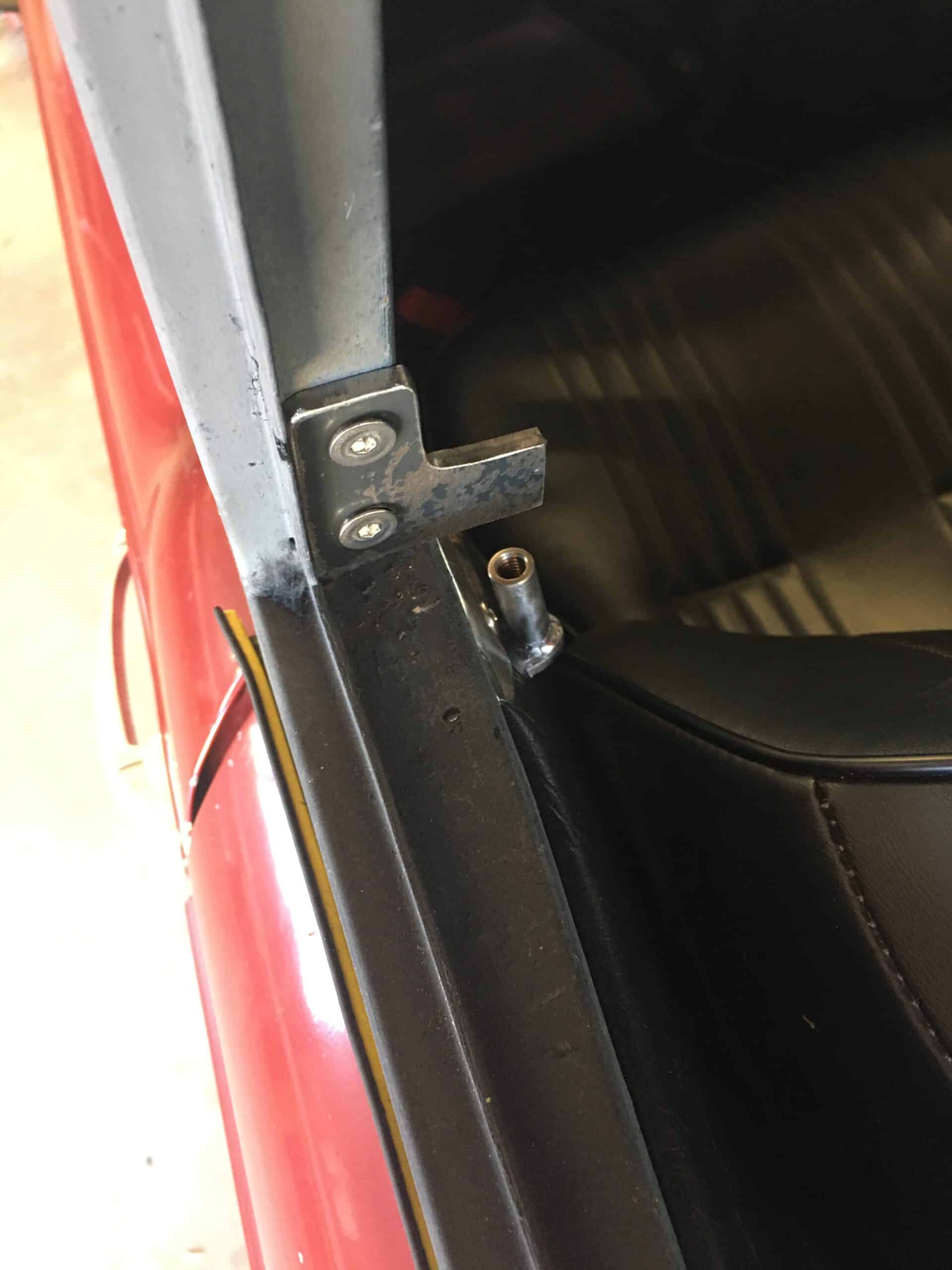
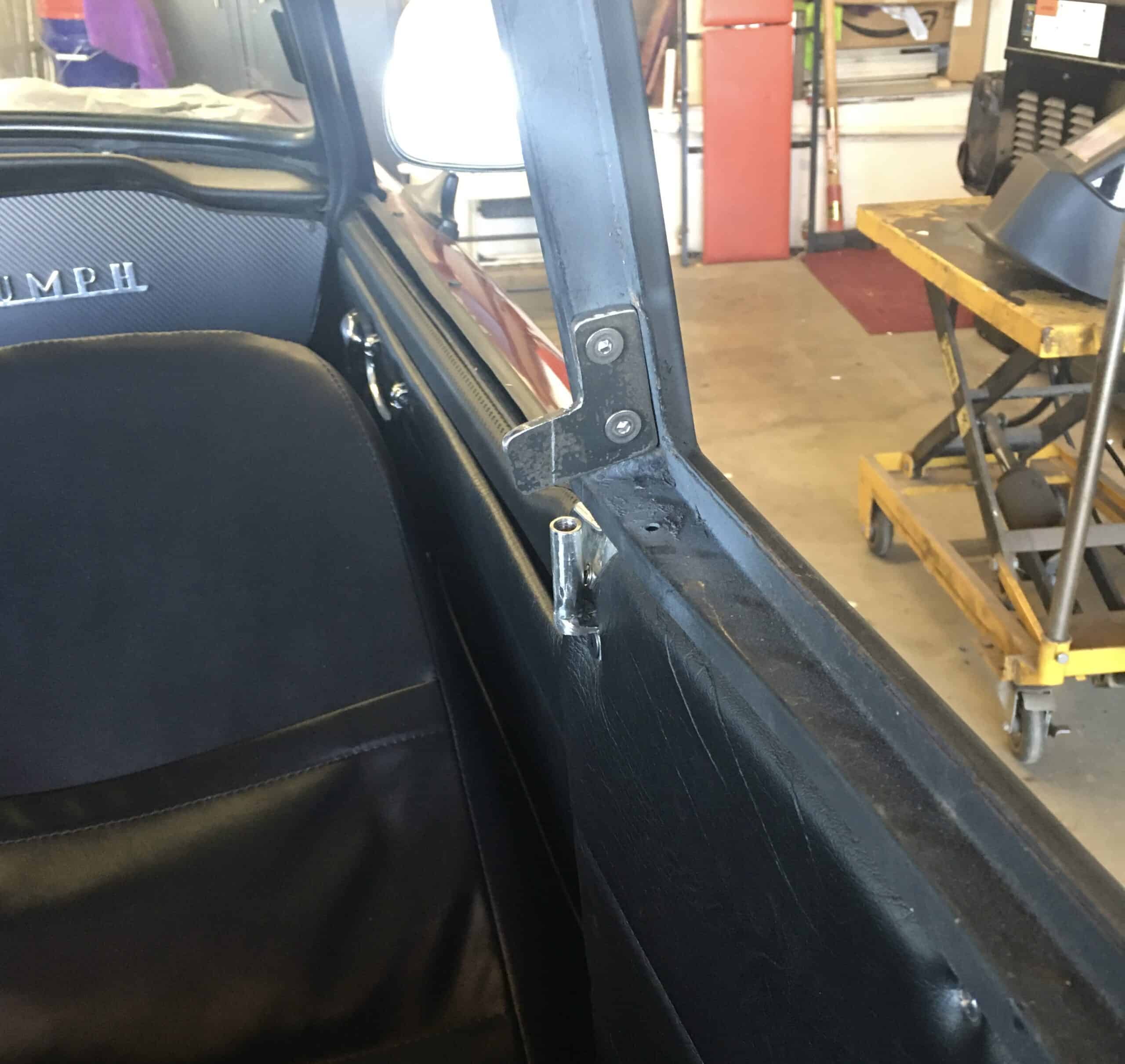
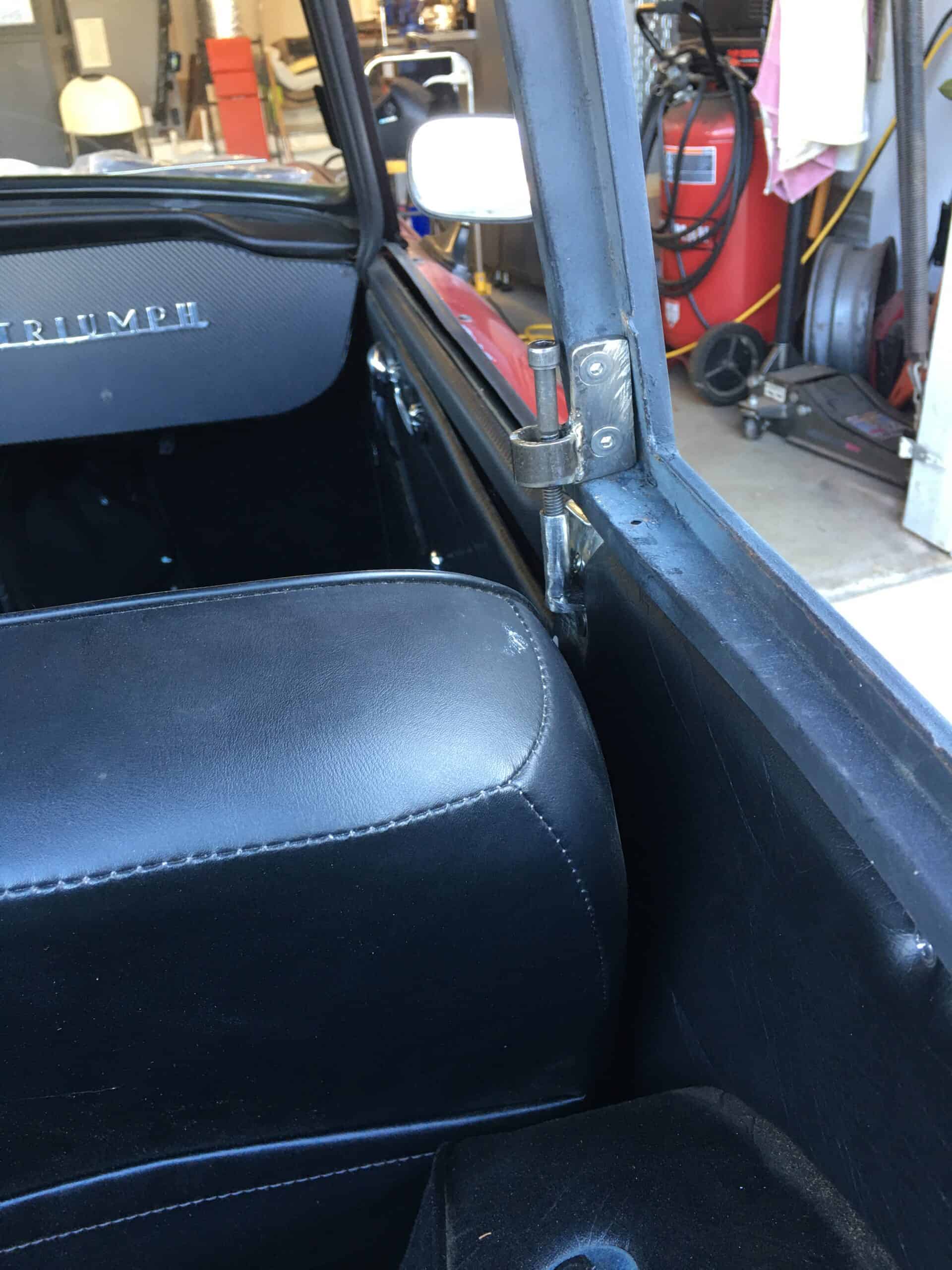
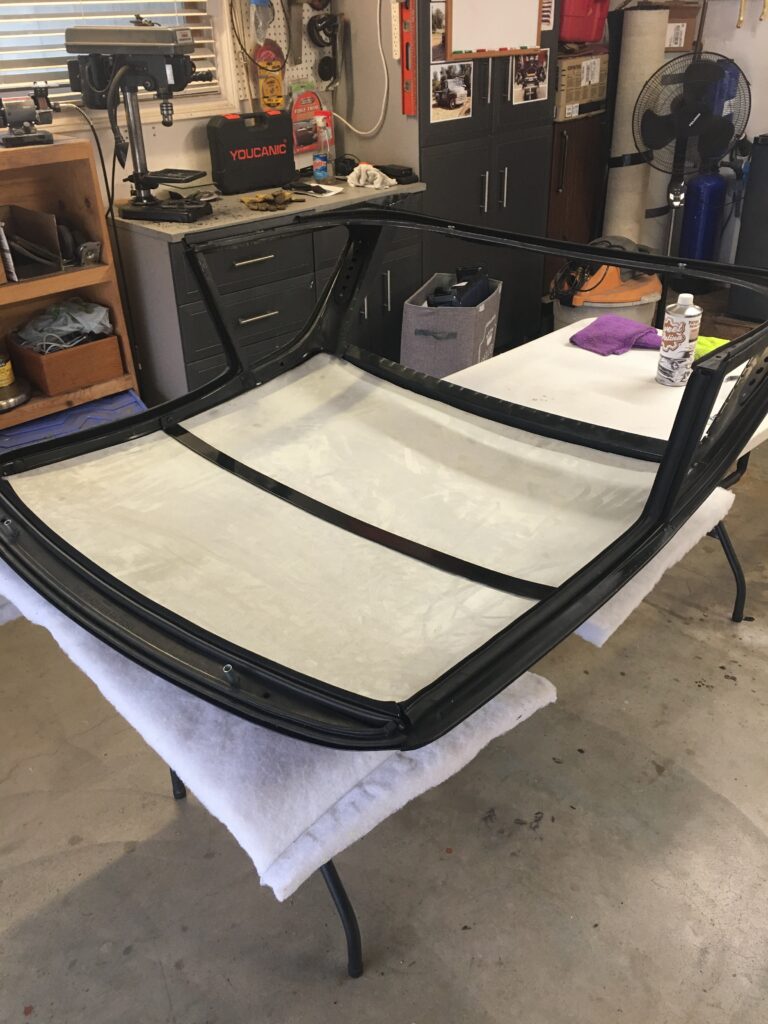
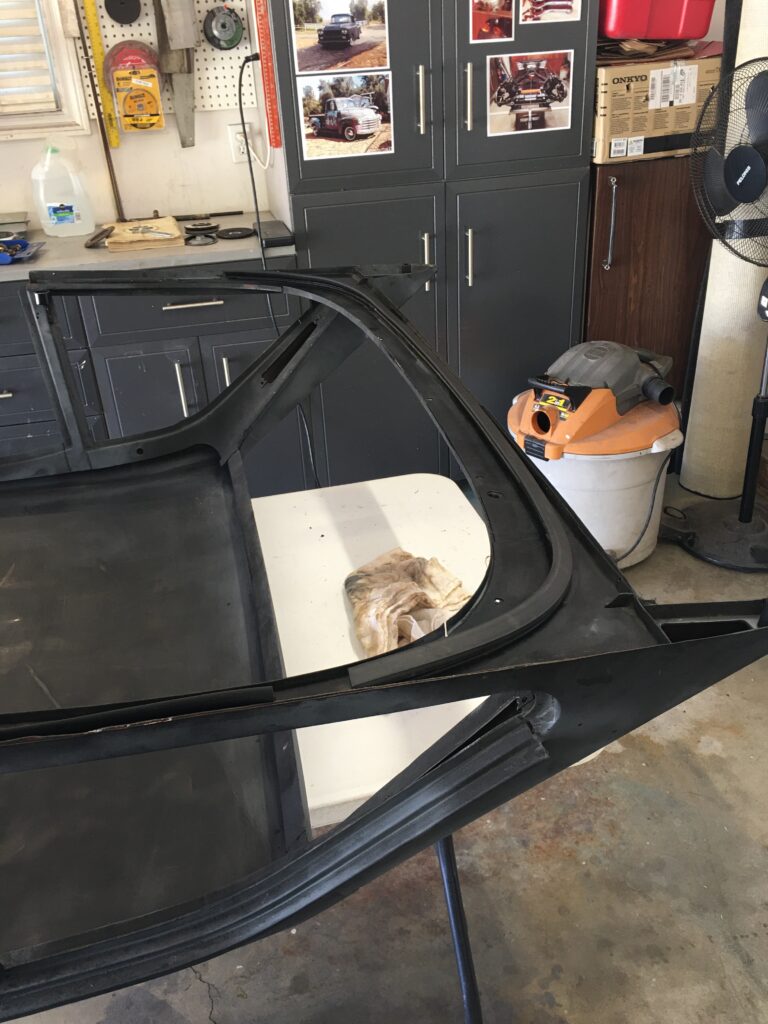
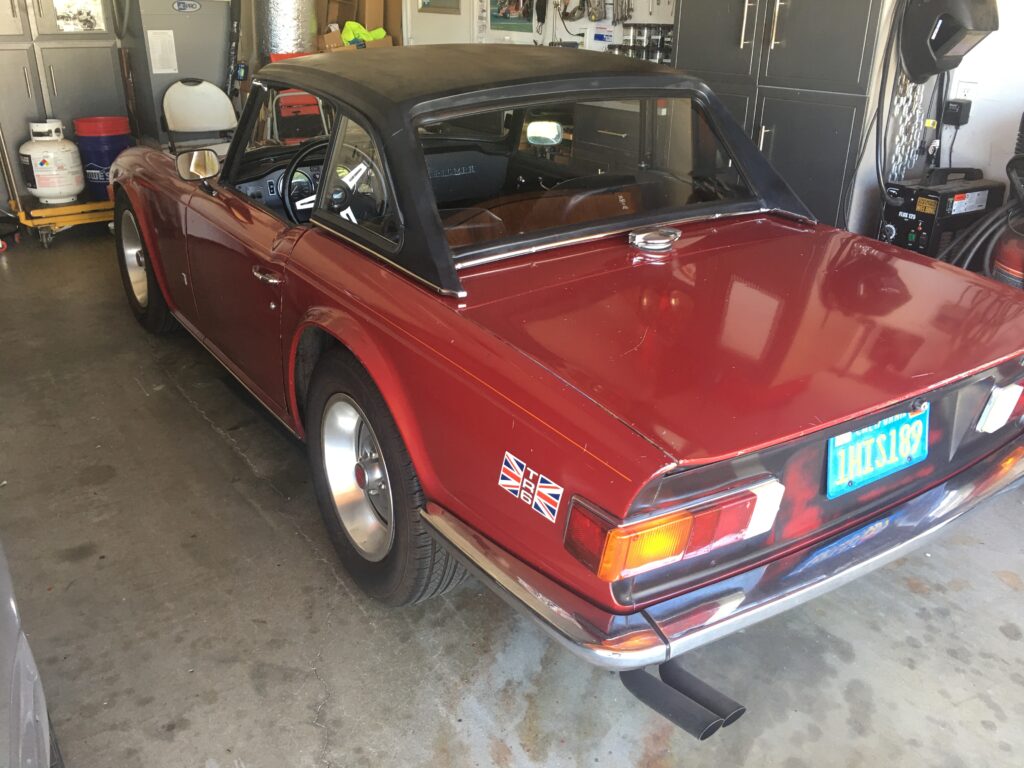
I have been half-heartedly looking for a factory hardtop for the Six, and this summer I lucked out and found one within an hour drive. It was a bare top but included all windows – in excellent shape – and some but not all of the rubber. The paint looks like rattle-can flat black and there are a couple very slight dents front and center, hardly noticeable now but which would need fixing prior to painting. I had to make the mounting brackets at the B-pillar, and I added insulation and headliner, as shown in the photos.
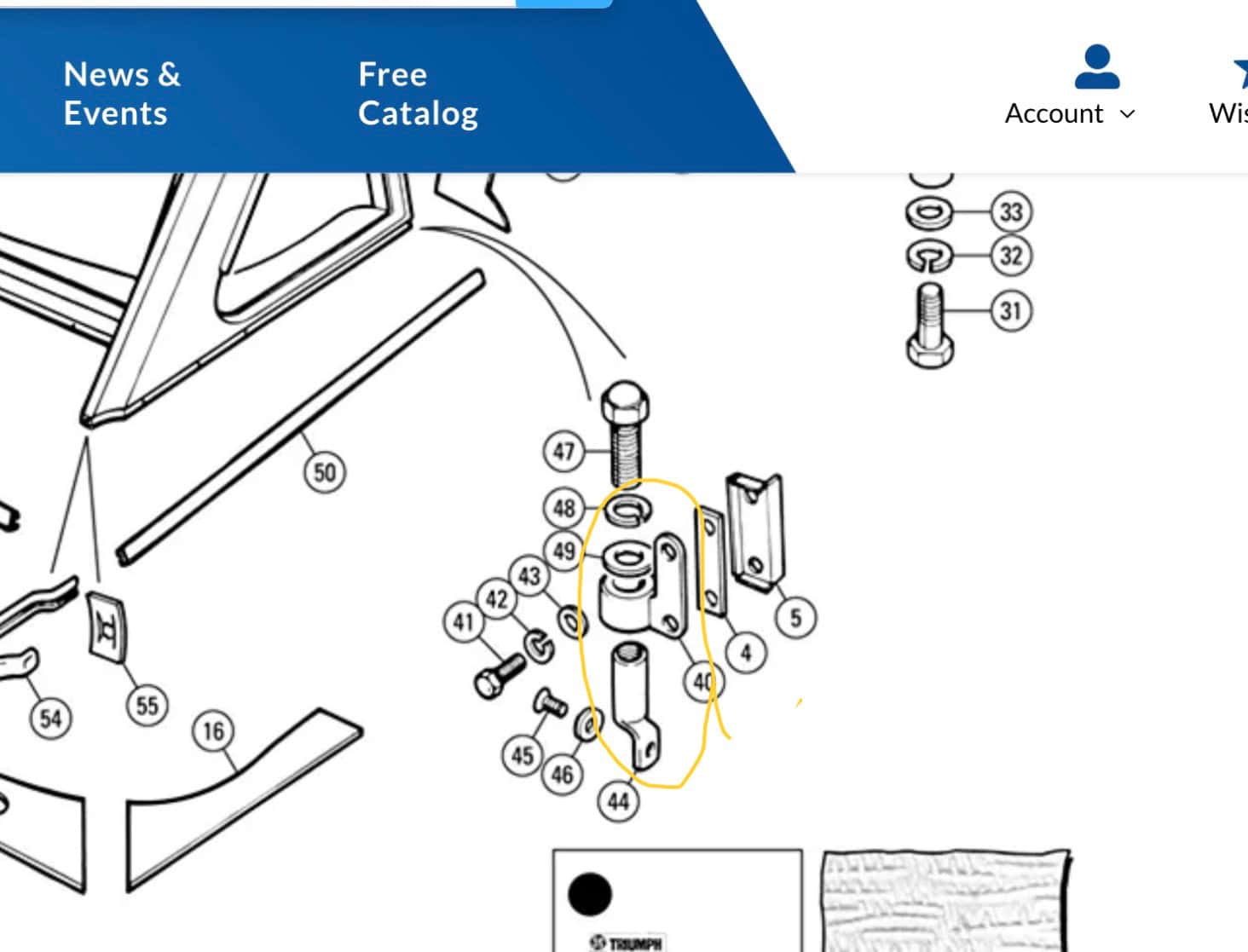
First, I made the B post brackets, which were either unavailable or crazy expensive.
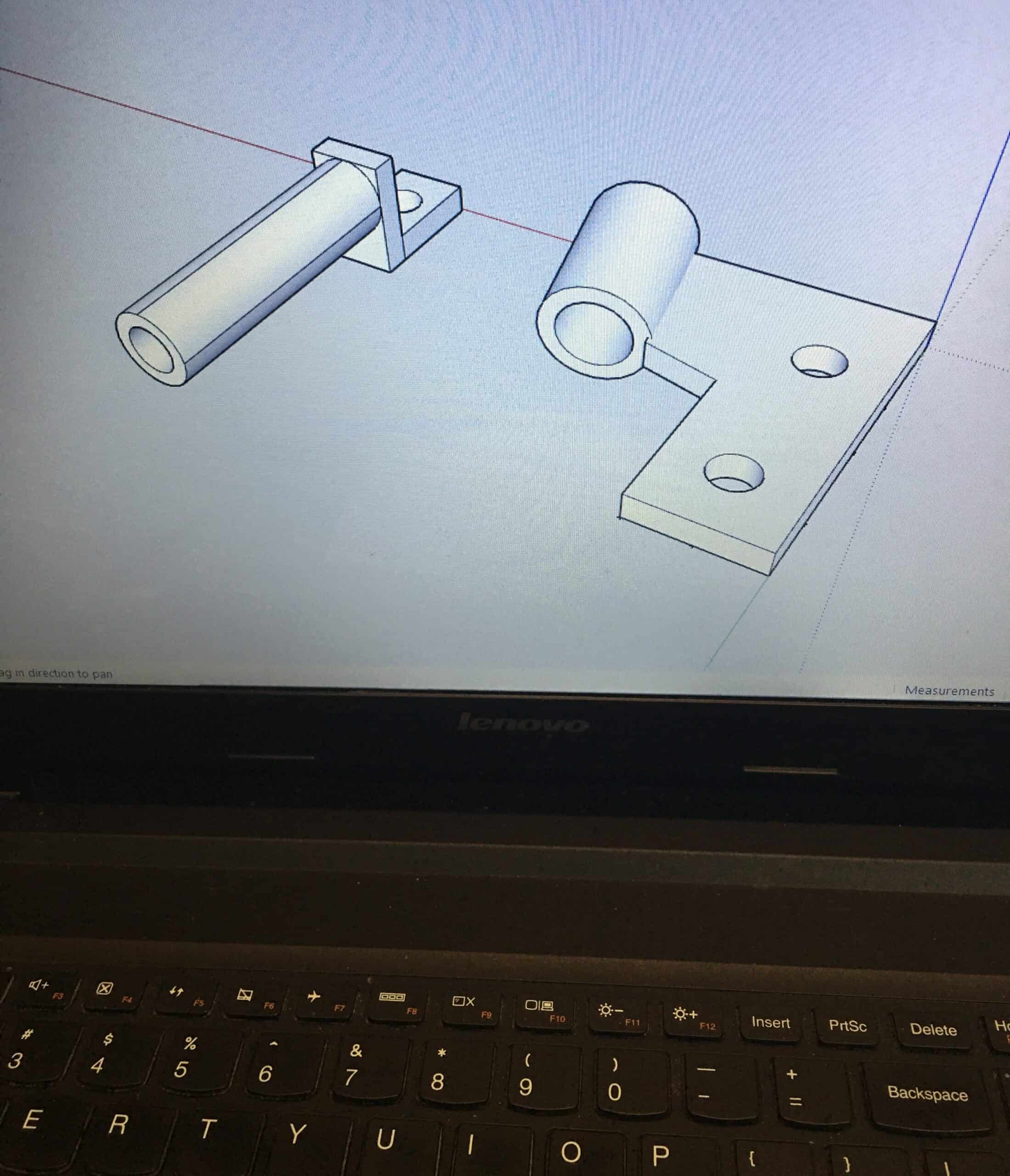
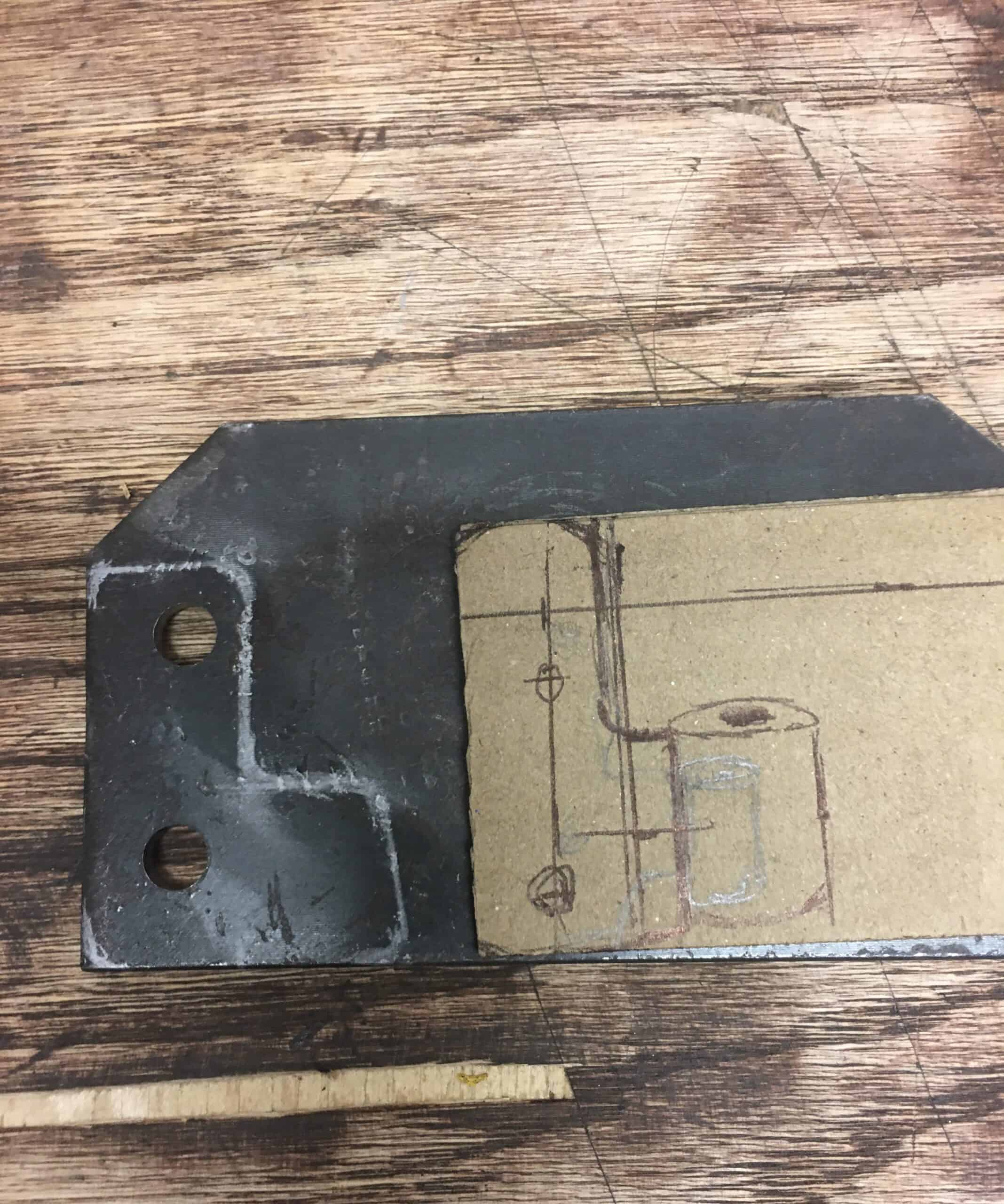
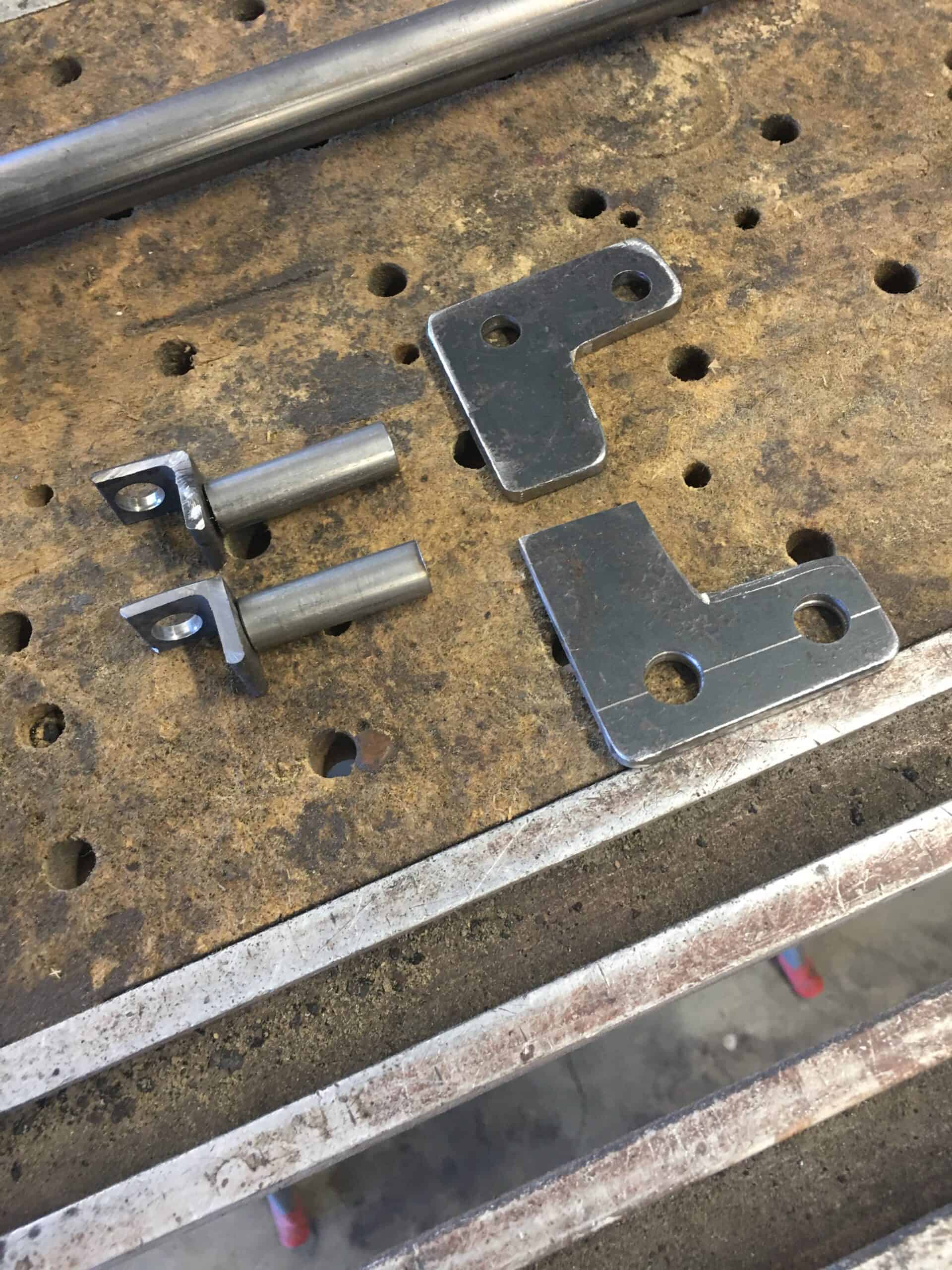
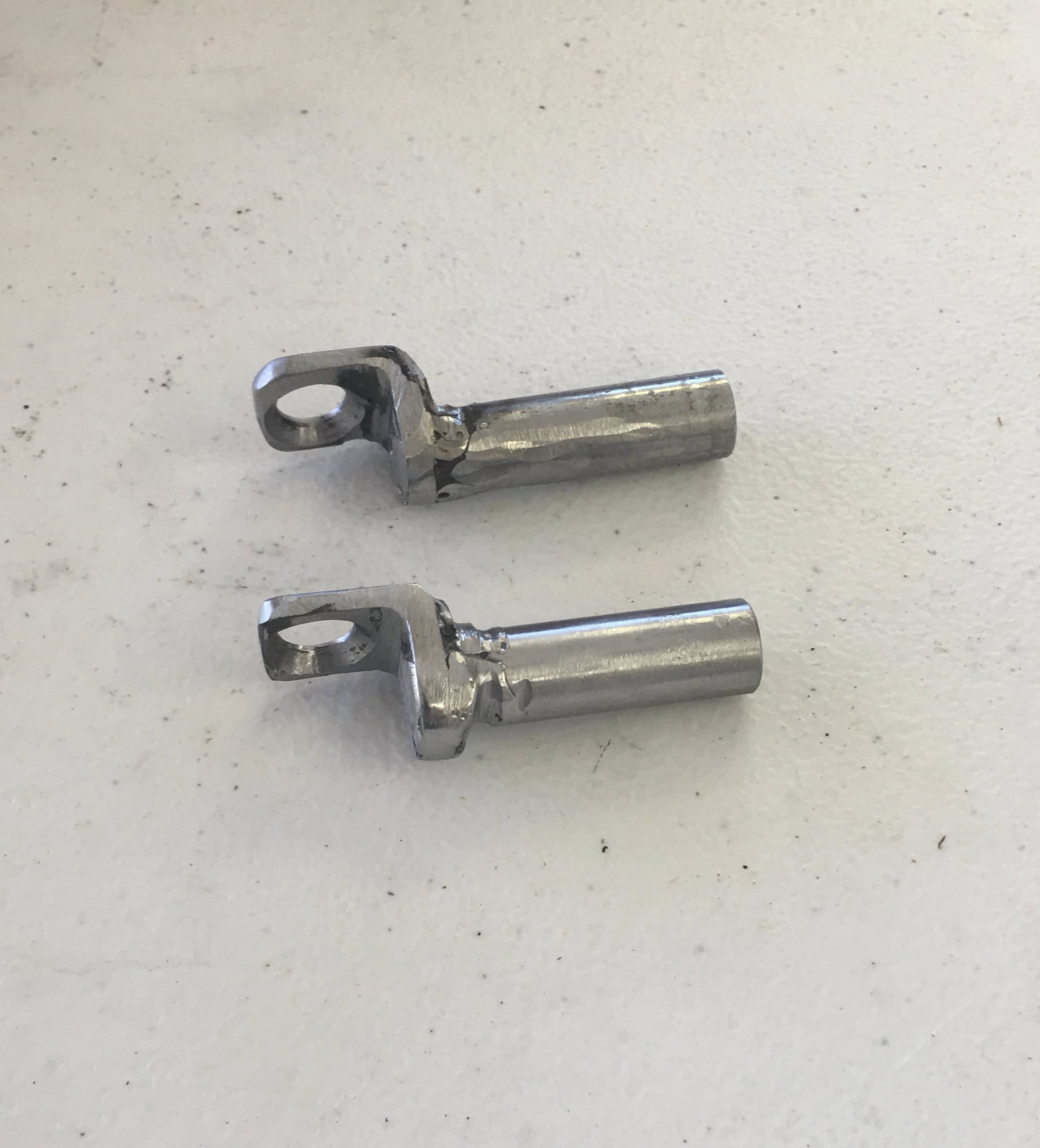
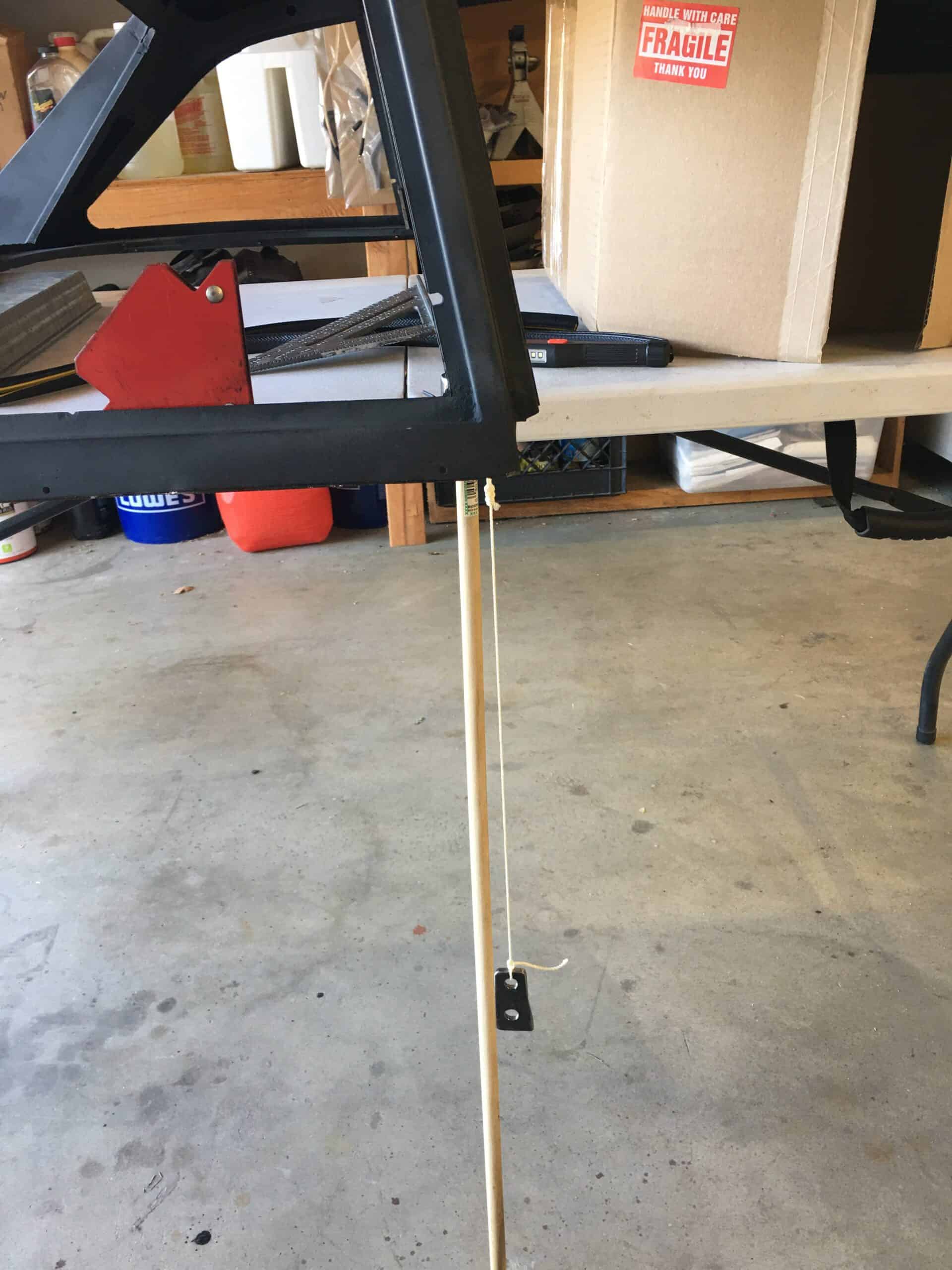
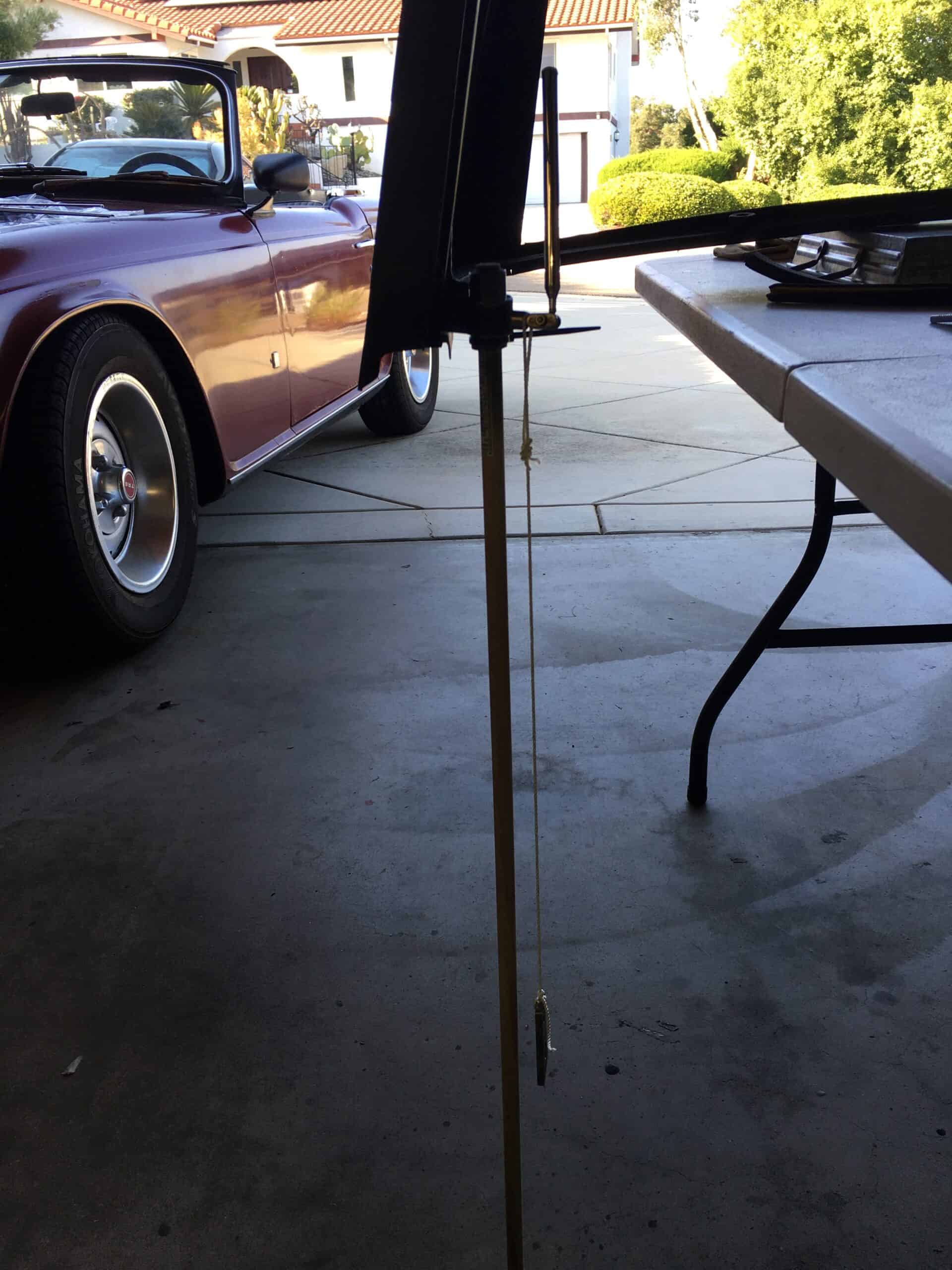
B post brackets were unobtaniumSketchUp to visualize what I needed to makeTime to cut some metal, 3/16th steelAngle iron, internally threaded tube, and the 3/16th platesWelds are a bit rough because I didn’t use our gas shielded rig at the barn, but good enoughTest fittingGetting the top level for the next stepPlumb bobbing, there are two angles to deal with… just trying to get close.The B-post leans toward center of the car and leans toward the rear, so we are plumbobbulating. Your new word for the day.Eye-ballingDrawing lines and eye-balling againA little black paint, a couple washers, and we’re doneFinished B-post bracket, not perfectly aligned, but the top is easy to install and it’s not going to fly off
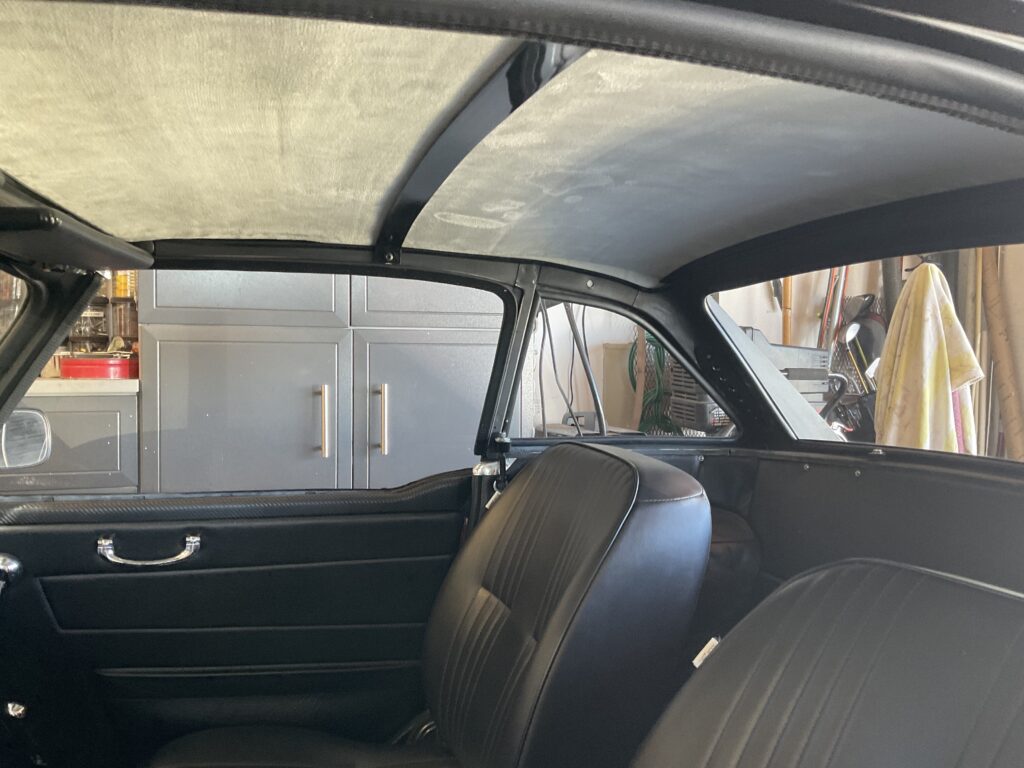
Although I’m not finishing the top at this time, I did want to experience enclosed driving through the winter, and decided to try and make it quiet with insulation and headliner.
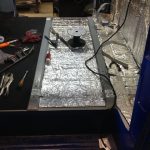
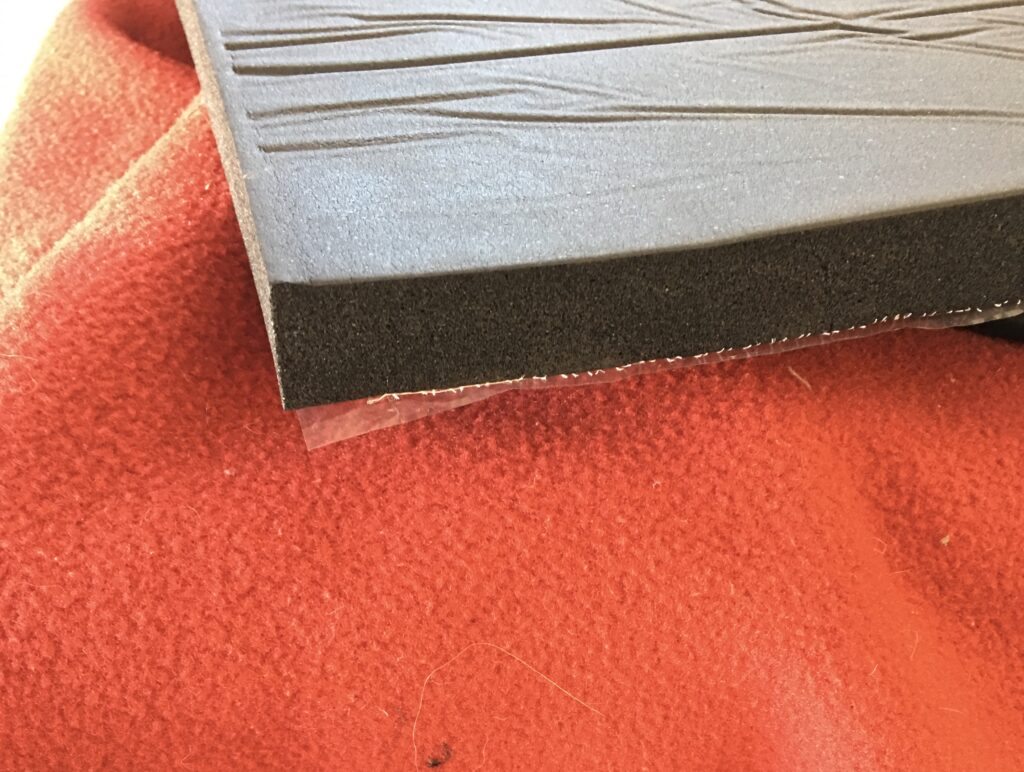
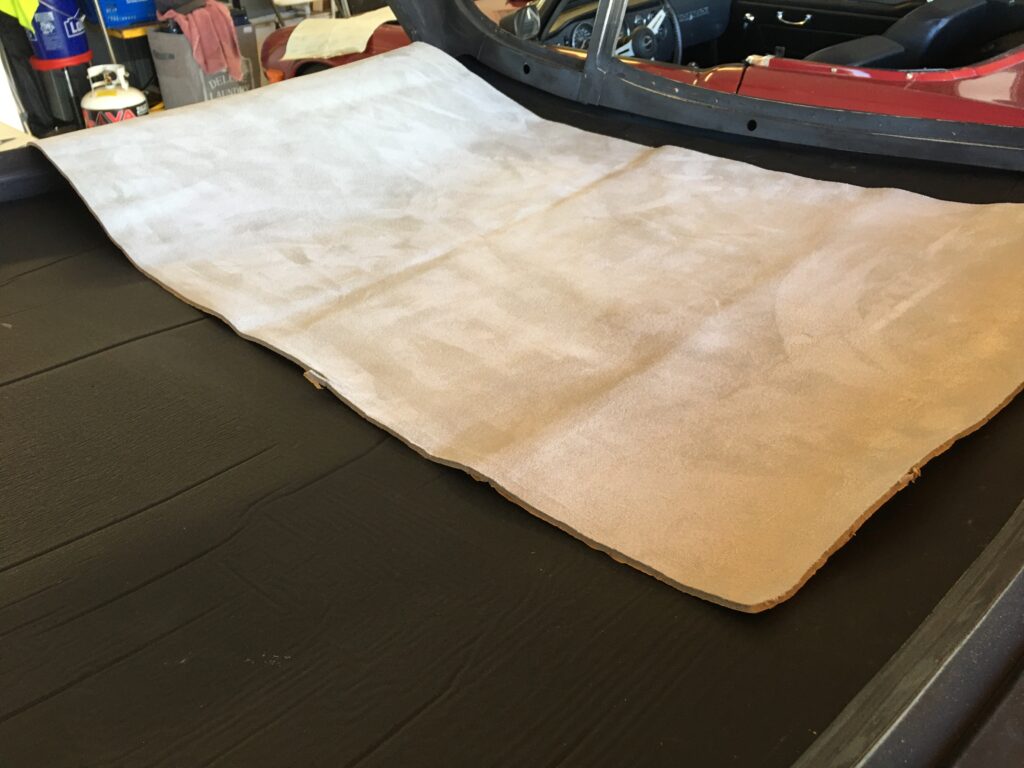
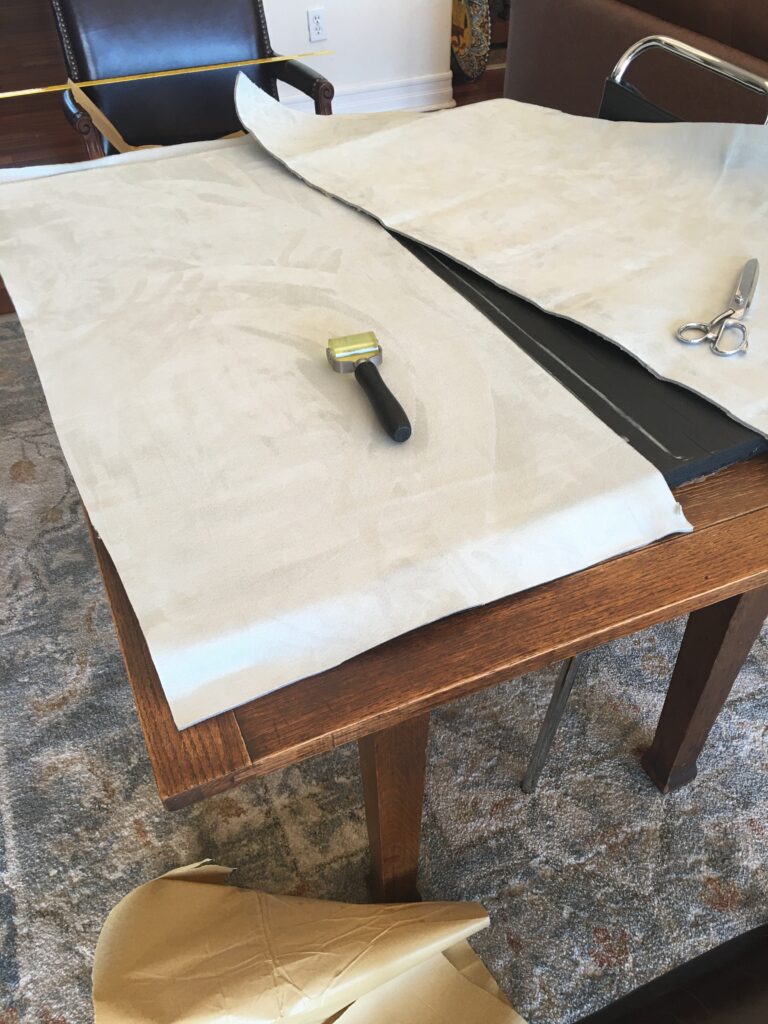
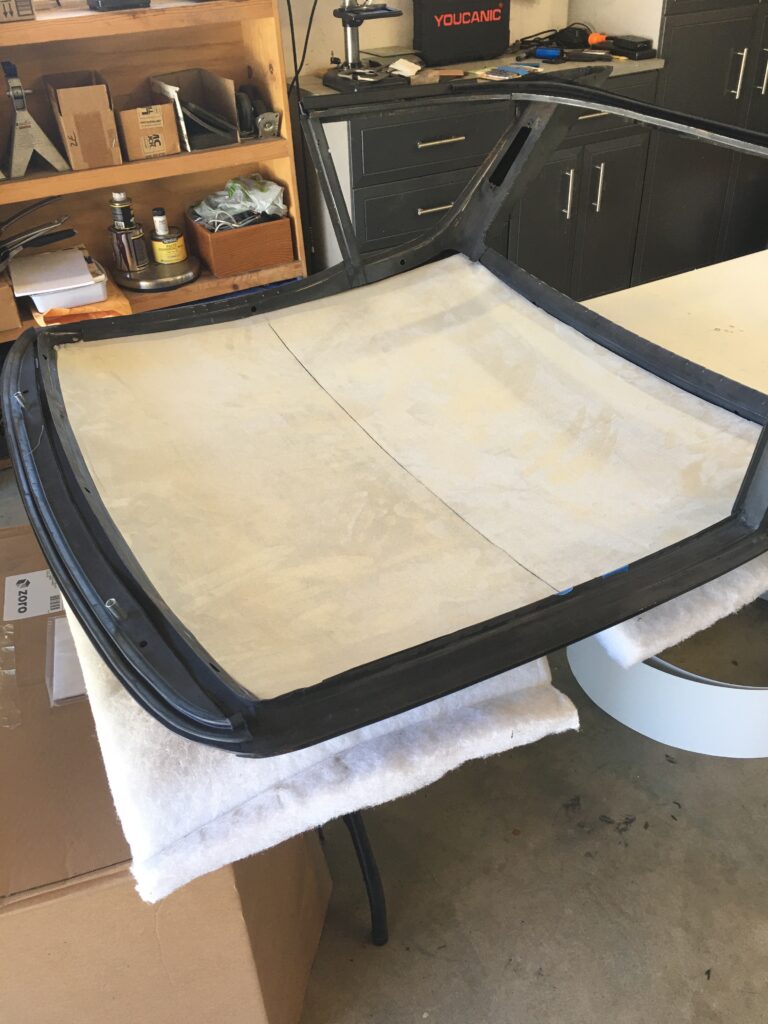
Adhesive backed 3/4 inch foamNice soft suede, 1/4 inch foam, also adhesive backedTest fitting the insulationGetting set to cut the headliner to fit the 3/4 insulationThe suede headliner I selected required a two-piece approachAll stuck togetherMetal rib covers the seamNot a bad result, with a total of an inch insulation, around $100 for the materials
The final steps included installation of the seals, the glass, and the chrome trim. I chose to have the glass done by Grace Auto Glass, as I had used them previously when assembling the windshield a few years ago.
It seemed to me there were some conflicting and incorrect comments re installing the seal between the hardtop and the windshield. So, quoting the official Fitting Instructions for Item 11, the Hardtop to Windshield seal, this is the process I followed…
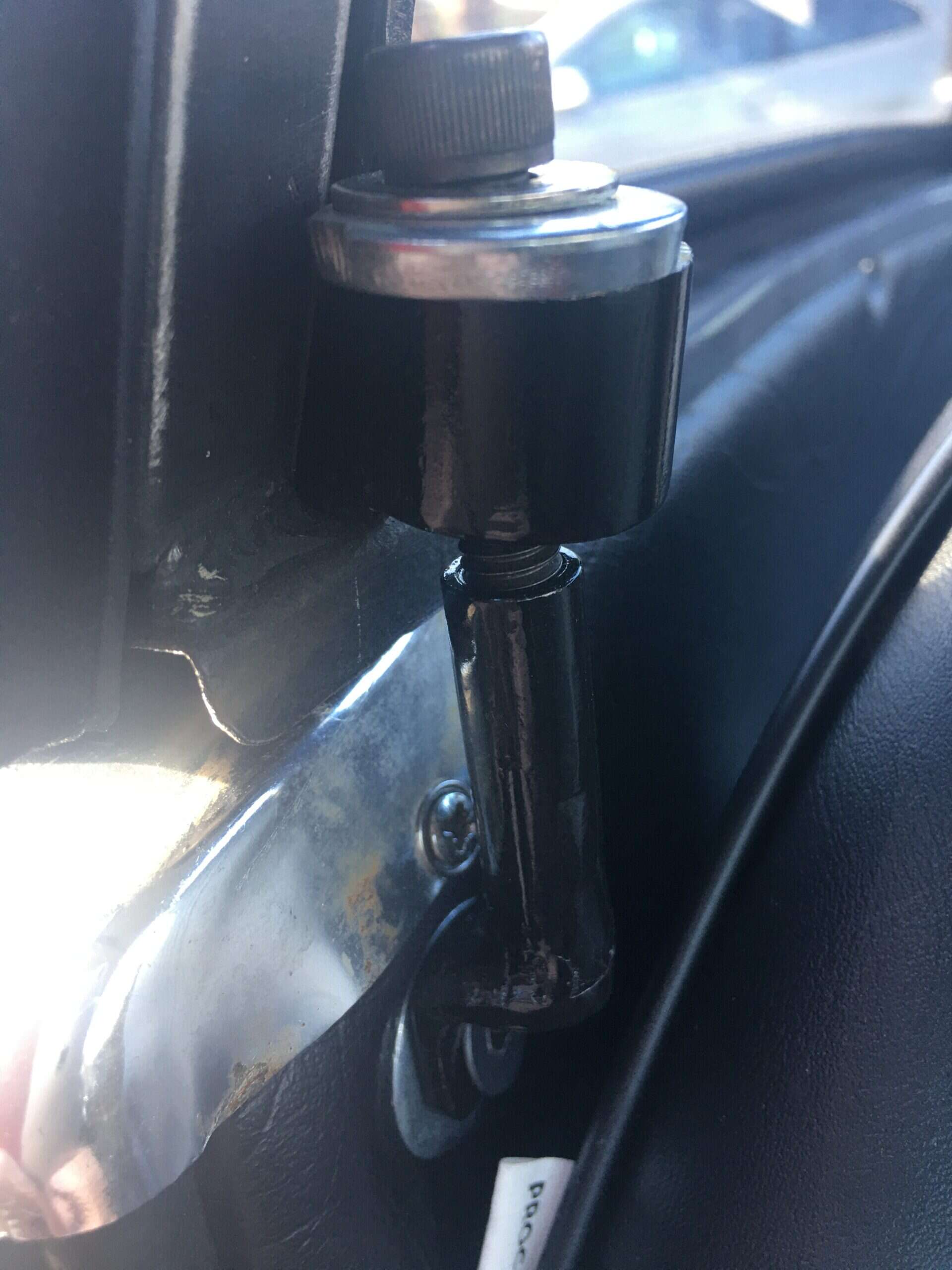
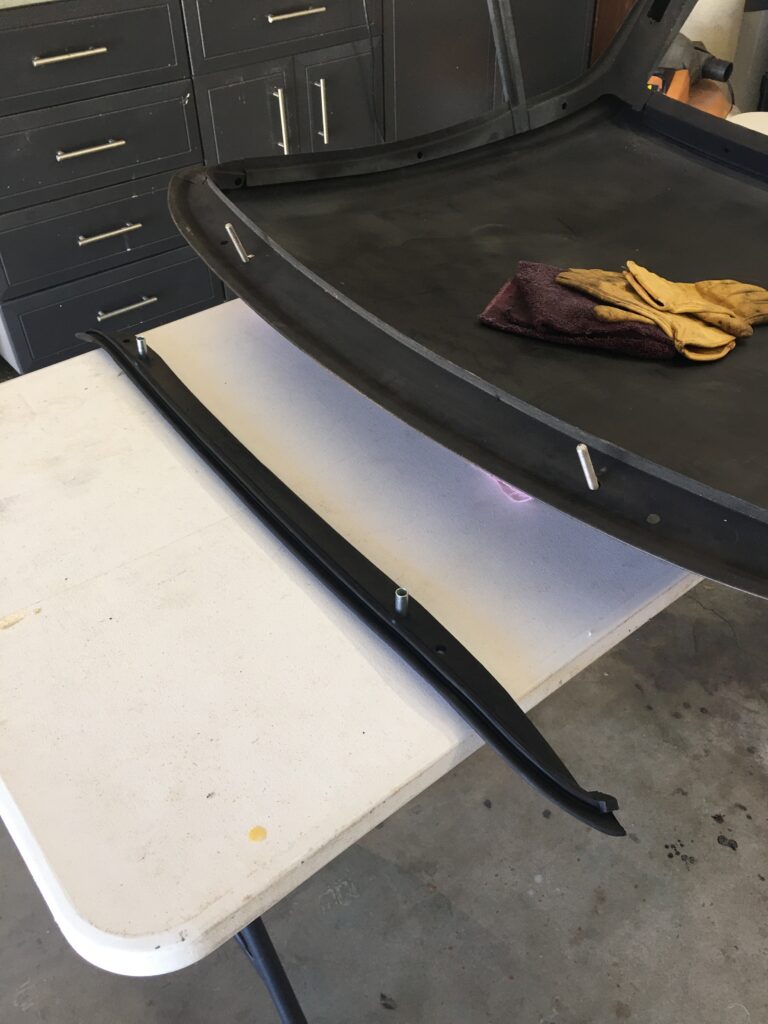
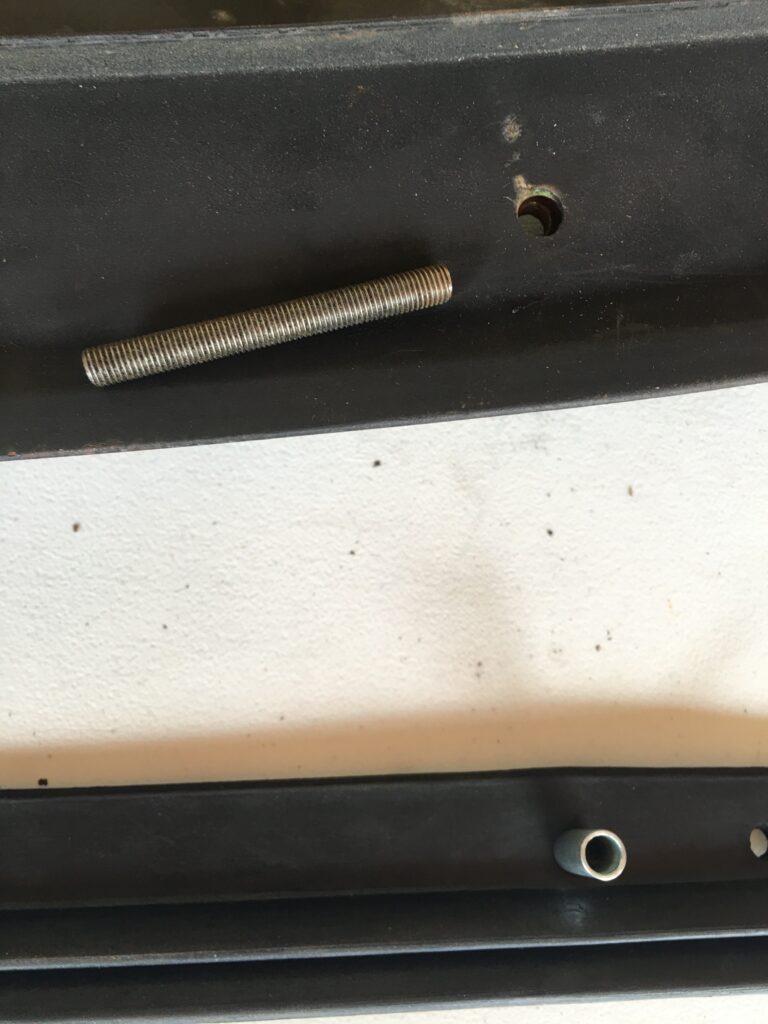
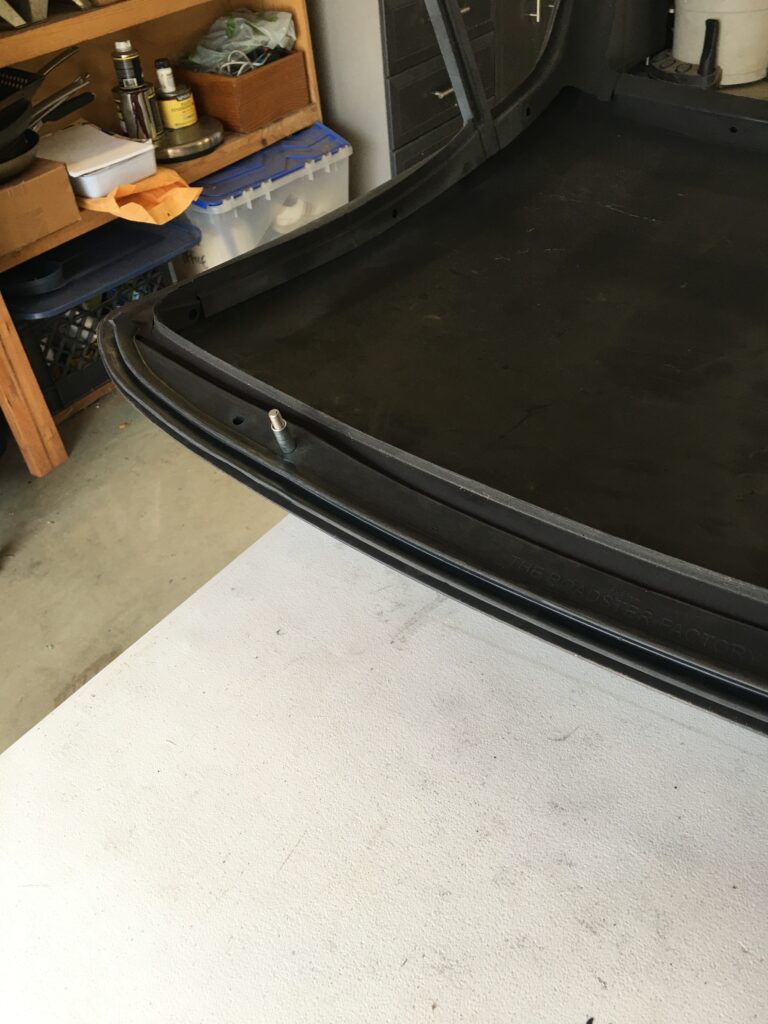
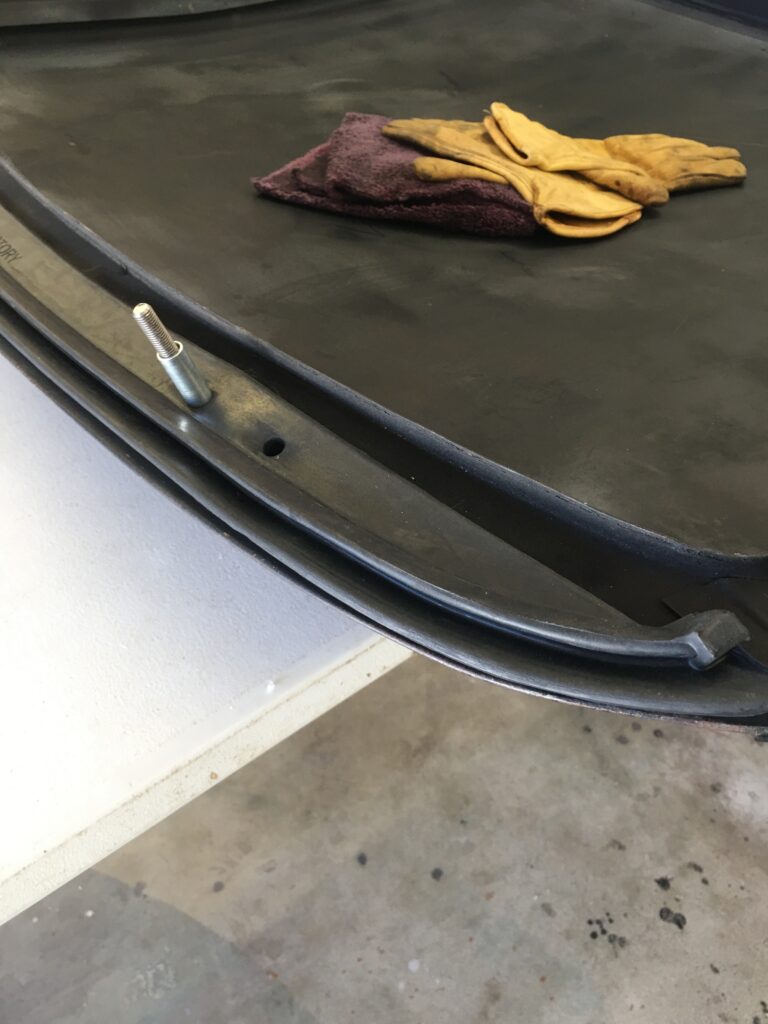
Place the rubber with flat side facing upwards and apply adhesive to the complete area of the flat surface. Insert distance tubes through the inner holes of the rubber. Screw a 5/16 inch “slave” stud finger tight to each of the two weld nuts in the header panel of the Hard Top, in order to locate the exact position of the rubber. Position the rubber to header rail and press down firmly to ensure satisfactory bond. Remove “slave” studs.
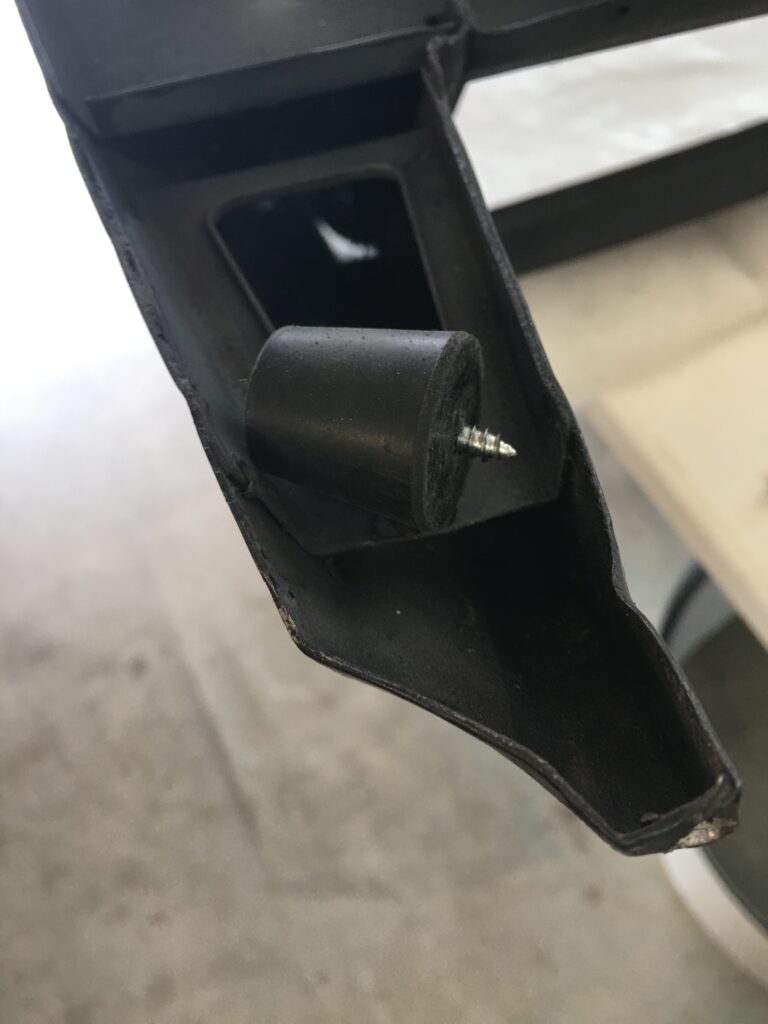
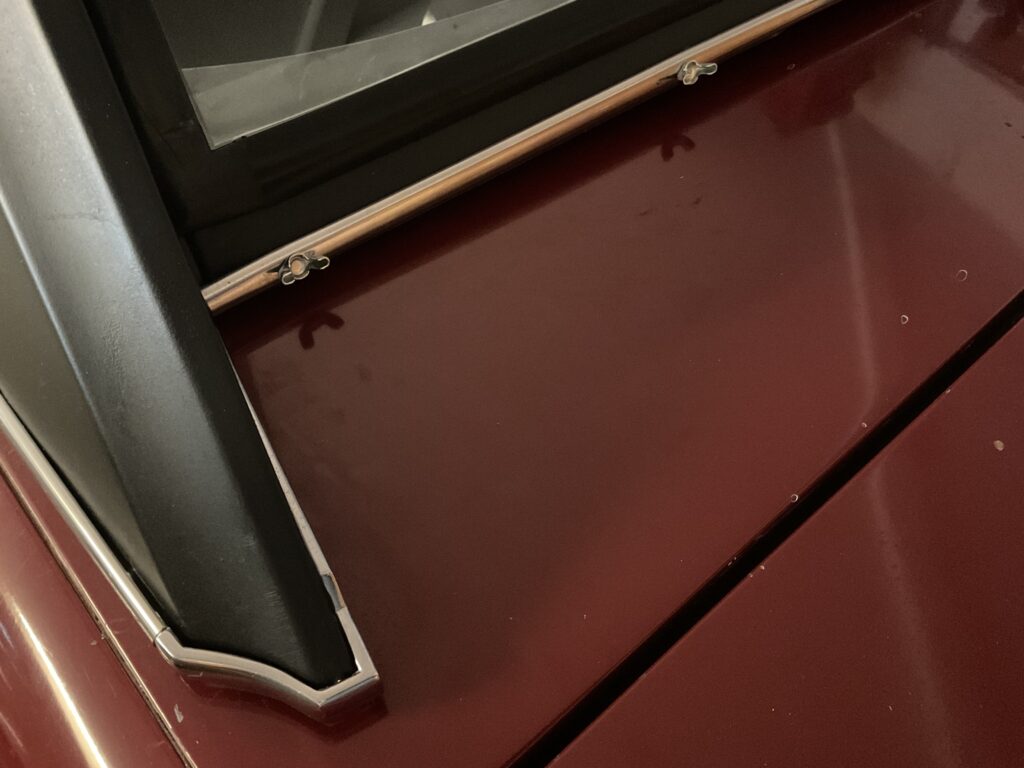
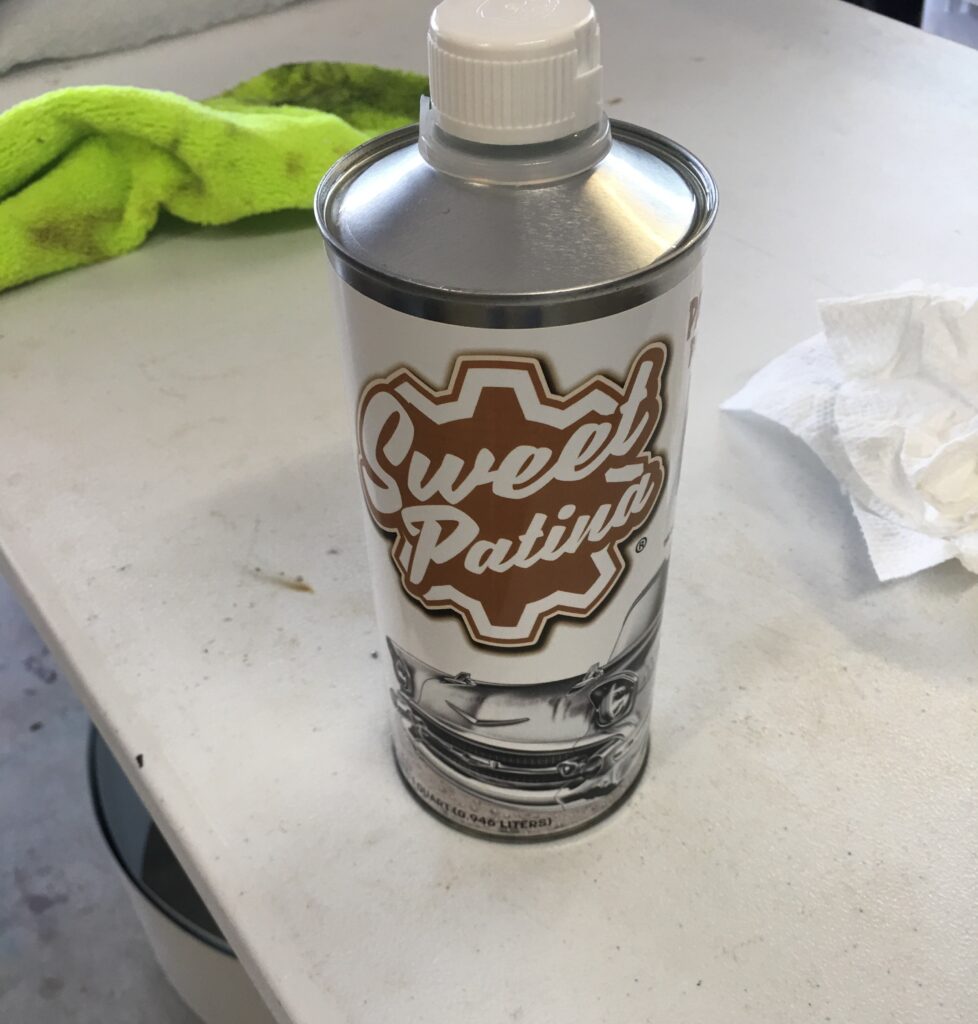
HT to WS seal, studs finger tight into captive nuts, distance pieces inserted through the rubber seal, ready to apply adhesive5/16 – 18 studsGlued, but I did not apply adhesive across the entire seal, just from a few inches inboard of the distance pieces and out to the endsGlued down, and ready to unscrew the “slave” studsThis seal was a bit tricky, but after cleaning up the channel, and slightly opening up the channel around the sweeping 90 degree turn, it slid in pretty easily. I then tightened the channel up a bit with pliersTrip to Ace Hardware for these stoppers that I drilled through to use as the buffers between HT and rear deckInstalled, with glass and chrome!I could not get the long chrome piece to stay on the rivets, so I got creative. Oh wellSince I am holding off on painting the top (and the entire car) I applied Sweet Patina on the top to offer a little protection against the elements this winter.
The Six actually seems like a real car now rather than a toy, but I’m pretty sure that come next spring the hardtop will be coming back off. For now, I will experience cozy comfort through the San Diego “winter.”
A conversation about Citizens United, corporate campaign finance, Super PACs, and the 2024 Ohio Senate race
August 2026
The Barn
So, a political question… a corporation can go shopping for a potential winning candidate for the US Senate, fund the campaign, and if he wins he receives a luxurious life with good salary, good health care, good retirement. Does that just about sum it up?
The Mack
Broadly, there is a kernel of truth there, but an important legal distinction changes the picture.
A corporation cannot simply select a Senate candidate and pour unlimited corporate treasury money directly into that candidate’s campaign. Direct corporate contributions to federal candidates are prohibited. Individuals and certain PACs can contribute directly, but under contribution limits.
What changed dramatically after Citizens United v. FEC (2010) is that corporations can spend unlimited amounts independently advocating for the election or defeat of candidates. They can also provide money to organizations such as Super PACs that make independent expenditures. Legally, those expenditures cannot be coordinated with the candidate or campaign.
The Barn
That seems a pretty subtle, perhaps illusionary difference from my original premise. So a maze has been set up through which a corporation must find its way, but the road map is well established.
The Mack
Yes—with one qualification. Your description captures a reasonable criticism of how the system functions, even though the legal distinctions aren’t entirely illusory.
The “maze” is indeed well established. A corporation cannot hand Candidate Jones $20 million. But corporate money can travel through legally recognized channels—independent expenditures, Super PACs, trade associations and some nonprofit organizations—to support candidates and political causes.
The distinction the Supreme Court considers crucial is independence. If the corporation spends $20 million saying “Elect Jones” without coordinating with Jones, that is protected political speech. If it gives Jones $20 million to spend however he wants, that’s an illegal corporate campaign contribution. And if the money is offered in exchange for an official act, you’re in bribery territory.
The Barn
Can you summarize the Citizen’s United case and ruling for me?
The Mack
Certainly. Citizens United is much easier to understand if we separate what happened in the case from the much larger rule the Supreme Court ultimately announced.
The impetus behind Citizens United
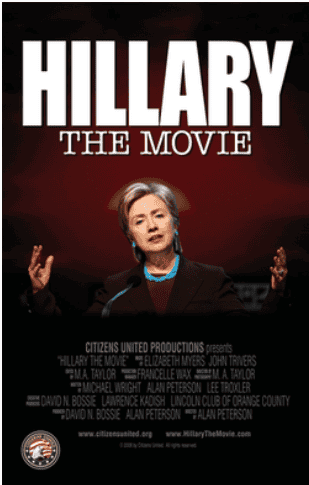
Citizens United was a nonprofit corporation that produced Hillary: The Movie, highly critical of Hillary Clinton while Clinton was seeking the Democratic presidential nomination in 2008. Citizens United wanted to distribute and advertise the film close to the election.
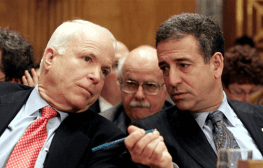
McCain – Feingold got it right(er)
A federal campaign-finance law—the Bipartisan Campaign Reform Act of 2002 (McCain-Feingold)—restricted corporations and unions from using their general treasury funds for certain election-related communications shortly before federal elections. Citizens United challenged those restrictions as violating the First Amendment’s protection of free speech.
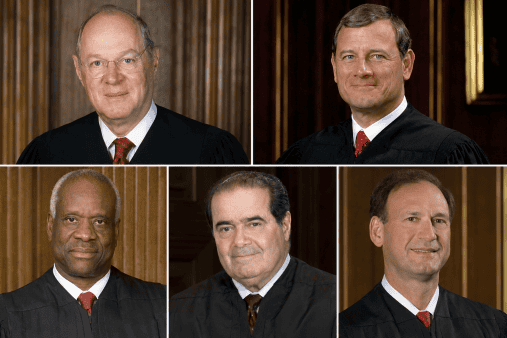
In January 2010, the Supreme Court ruled 5–4 in favor of Citizens United. The central principle was essentially: the government generally cannot prohibit political speech merely because the speaker is a corporation.
Kennedy wrote majority opinion; Roberts, Thomas, Scalia, and Alito joined.
The decision did not legalize unlimited corporate contributions directly to candidates. A corporation still cannot simply write a $20 million check to a candidate’s campaign. The distinction remained: direct contribution to candidate—restricted/prohibited; independent spending advocating Candidate Smith’s election—constitutionally protected.
Later in 2010, SpeechNow.org v. FEC, applying the reasoning of Citizens United, concluded that organizations making only independent expenditures could accept unlimited contributions. Put together, the decisions produced much of the modern Super PAC system.
The Barn
Under the McCain-Feingold Act, how was “shortly before” federal elections defined?
The Mack
Under the Bipartisan Campaign Reform Act of 2002 (McCain–Feingold), the relevant provision defined an “electioneering communication” as certain broadcast, cable, or satellite communications that clearly identified a federal candidate and were aired within 30 days before a primary election or nominating convention, or within 60 days before a general election.
The Barn
Let’s look at an actual Senate race, vis a vis campaign financing
The Mack
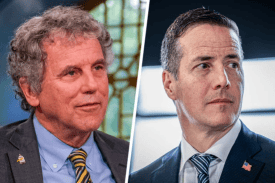
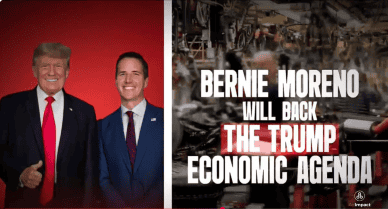
Given what we’ve been discussing, the 2024 Ohio Senate race between Democratic incumbent Sherrod Brown and Republican challenger Bernie Moreno is almost a laboratory demonstration of the system. It was extraordinarily expensive, involved enormous amounts of outside money, and Moreno won.
Brown v Moreno 2024 Ohio Senate race
Brown’s campaign raised far more than Moreno’s own campaign, but outside Republican groups supplied enormous support for Moreno. The cryptocurrency industry provides a particularly clear example. A network of crypto-funded Super PACs announced substantial spending to help elect Moreno. Major financial backers included Coinbase, Ripple and venture-capital firm Andreessen Horowitz. Moreno was considered friendly toward cryptocurrency; Brown, who chaired the Senate Banking Committee, had been a prominent crypto skeptic.
Crypto spent $40 million advocating Moreno, and never mentioned Crypto
The money trail looked approximately like this: crypto companies and investors → independent Super PAC → millions of dollars of advertising supporting Moreno → voters elect Moreno → Moreno becomes U.S. Senator.
The Barn
Tell me more about the Moreno – Crypto connection.
The Mack
This is where the example becomes especially useful, because we can compare money before the election with governmental action afterward—while being careful not to confuse correlation with proof of a bargain.
Defend American Jobs, part of a network including Fairshake and Protect Progress, spent roughly $40 million supporting Bernie Moreno. Major supporters of the network included Coinbase, Ripple and Andreessen Horowitz. Much of the advertising itself did not talk about cryptocurrency; it used conventional political themes designed to persuade Ohio voters.
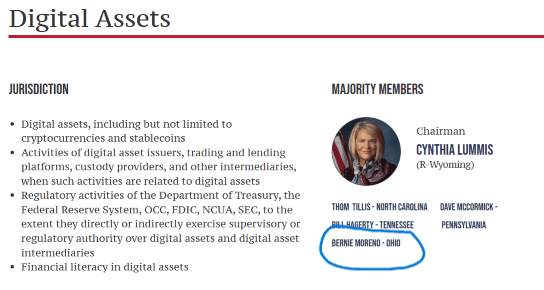
After winning, Moreno was appointed to the Senate Banking, Housing and Urban Affairs Committee and its Digital Assets Subcommittee. That sequence is factual, but it does not demonstrate that the industry purchased the committee assignment nor does it establish a quid pro quo.
Congress subsequently considered major cryptocurrency legislation, including the GENIUS Act governing payment stablecoins. Moreno supported it, but so did many Democrats; the legislation received substantial bipartisan support.
The broader phenomenon is a political feedback loop: industry accumulates enormous economic resources → industry finances independent political organizations → organizations identify sympathetic candidates → organizations spend heavily helping elect them → successful candidates enter Congress → Congress considers legislation important to that industry → industry supports friendly legislators and threatens electoral opposition to hostile ones → next election, repeat.
That creates political influence without anyone ever needing to say, “Vote this way and we’ll give you money.”
The Barn
Just to be clear on one thing, since 2010 there is no restriction on the timing of a corporation or PAC ad promoting a candidate. In other words they can advertise right up through election day, correct?
The Mack
Yes, essentially correct.
After Citizens United, a corporation, union, Super PAC, or other independent spender can pay for an advertisement expressly supporting or opposing a federal candidate right up through Election Day, provided the expenditure is genuinely independent of the candidate’s campaign and complies with disclosure/disclaimer rules.
So the old McCain–Feingold 30-day-before-a-primary / 60-day-before-a-general-election restriction on corporate-funded “electioneering communications” no longer prohibits that spending.
The Barn
It seems like the removal of those 30/60 day restrictions can be an obstacle to actually hearing from the candidates. Why step in front of a camera or microphone when corporations and PACs have already painted the landscape, making a candidate appealing?
The Mack
Yes. I think you’ve identified a real incentive created by the modern system, although I’d separate it from what Citizens United legally decided.
A candidate can benefit enormously from outside organizations doing the political persuasion for him. If a Super PAC spends $30 million defining him as a successful businessman, defender of working families, tough on crime, etc., the candidate doesn’t necessarily need to expose himself to the risks inherent in a two-hour debate or an unscripted town hall.
Fairshake (crypto PAC) video advocating for Moreno, no mention of crypto
Those risks are asymmetric. A polished advertisement is completely controlled. A debate isn’t. One bad answer, an embarrassing exchange, or a 20-second clip that goes viral can overwhelm days of carefully constructed messaging.
I would hesitate to attribute the decline or avoidance of debates primarily to Citizens United. Targeted social-media advertising, partisan media, podcasts, campaign-controlled video, declining local journalism and voter databases also allow campaigns to reach selected voters without submitting candidates to uncontrolled questioning.
The democratic distinction is important: political advertising tells voters what someone wants them to believe about a candidate. A debate, town hall or adversarial interview lets voters observe the candidate thinking and responding for himself.
The Barn
Okay, can you inform me about personal appearances made by either candidate in the Brown/Moreno race.
The Mack
The Brown/Moreno race turns out to support your concern rather strikingly.
There was no general-election debate between Sherrod Brown and Bernie Moreno. Both men said they wanted to debate, but neither committed in a way that produced one, and the election took place without them facing one another in a general-election debate.
Meanwhile, voters were being inundated with political advertising in a race involving hundreds of millions of dollars. The contrast is striking: Ohioans experienced one of the most expensive Senate campaigns in American history—with enormous sums devoted to persuading them whom to elect—without the two candidates ever standing on the same general-election debate stage.
The Barn
Thank you, that was an informative conversation. We will pick it up again later.
The Mack
I enjoyed the discussion — from your original “corporation goes shopping” proposition, through Citizens United, and finally seeing how those abstractions played out in an actual Senate race.
The Brown–Moreno example gave us a particularly useful reality check: hundreds of millions spent communicating about two candidates who never actually debated each other. That’s a fact worth pondering.
The Barn
There are a number of websites that help us remove the veil and discover the candidates and the money behind them. The following post – Who Is This Candidate – reveals some of those sources.
What was our immigration policy in the late 1800s ?
The Mack
The easiest way to understand U.S. immigration from 1880 onward is as a series of fairly distinct eras. And one striking feature is that the immigration system we have today is quite different from the one the country had for most of the 20th century.
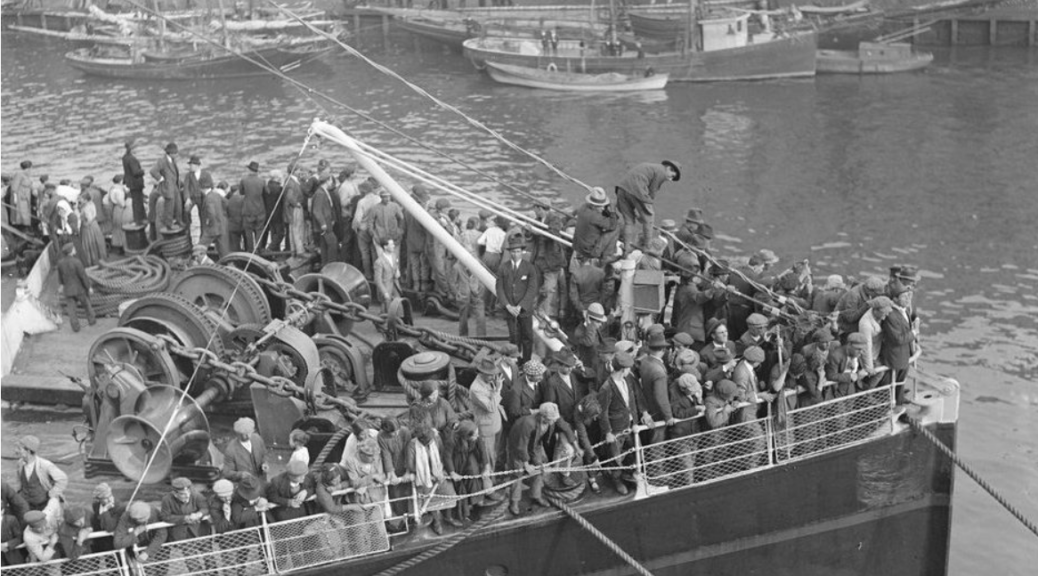
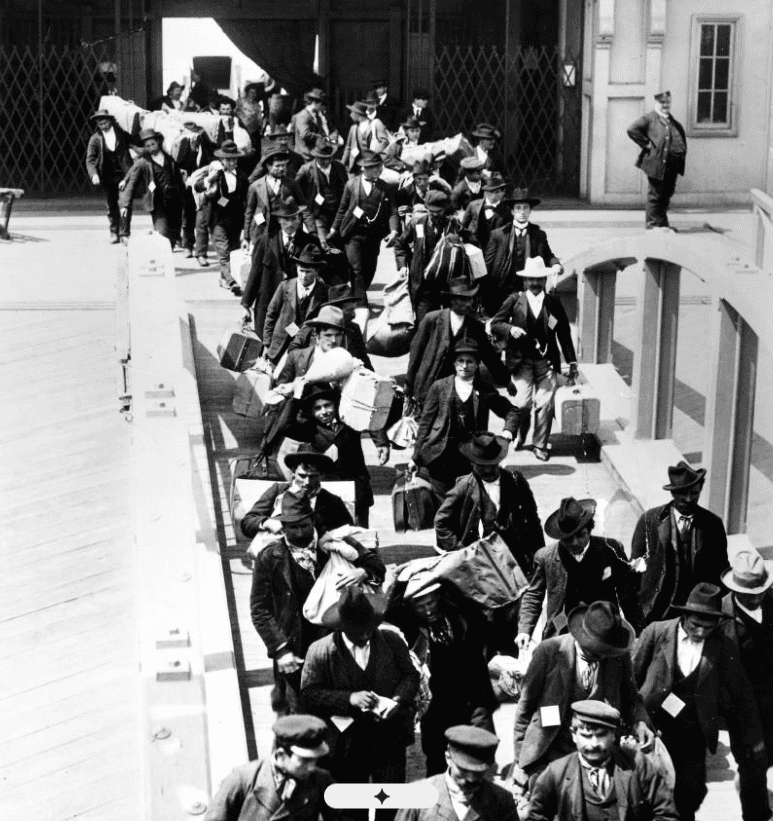
Around 1900, the United States was in the middle of one of history’s great migrations.
Between roughly 1880 and 1920, millions arrived, increasingly from Italy, Austria-Hungary, Russia, Poland and other parts of southern and eastern Europe, rather than the northern and western European countries that had supplied many earlier immigrants.
Give me your tired, your poor, your huddled masses yearning to breathe free
There was no general numerical ceiling on European immigration. If an immigrant arrived, passed inspection, wasn’t considered likely to become a public charge, didn’t have certain diseases or criminal problems, and wasn’t otherwise in an excluded category, he or she could generally enter.
But it wasn’t completely open immigration. The federal government had already begun excluding particular groups:
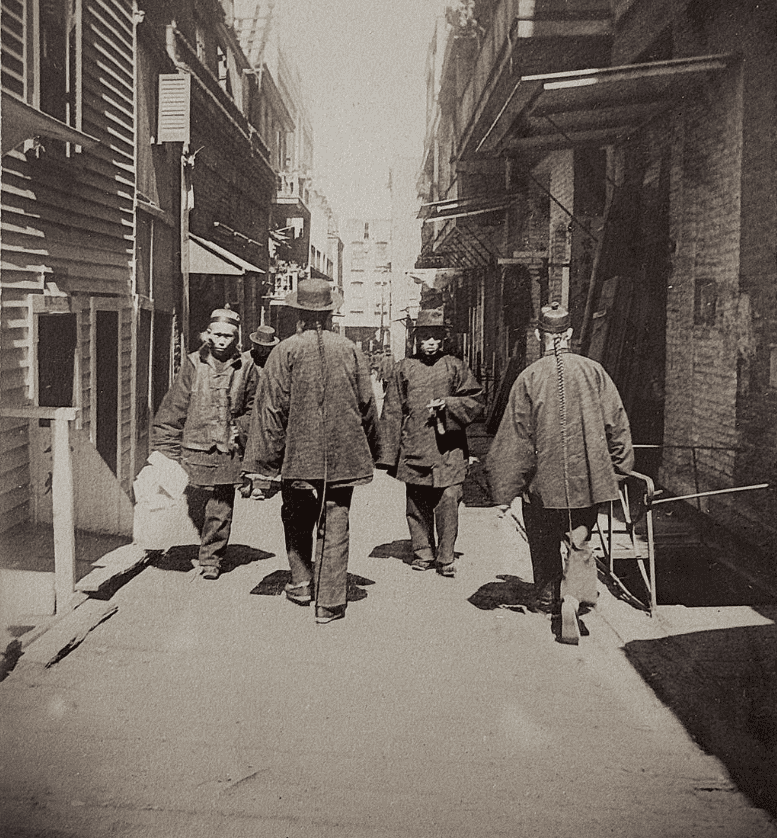
The Chinese Exclusion Act of 1882 essentially stopped Chinese labor immigration.
Contract labor laws restricted importing foreign workers under certain employment arrangements.
Anarchists, people with certain diseases, prostitutes and some other categories could be excluded.
Immigration officials could reject someone considered “likely to become a public charge.”
Mexico and Canada were comparatively unrestricted.
The Barn
Tell me a little more about the Chinese Exclusion Act of 1882
The Mack
It was the first major federal immigration law to exclude people principally on the basis of nationality and class, and it helped establish the federal government’s modern role in controlling immigration
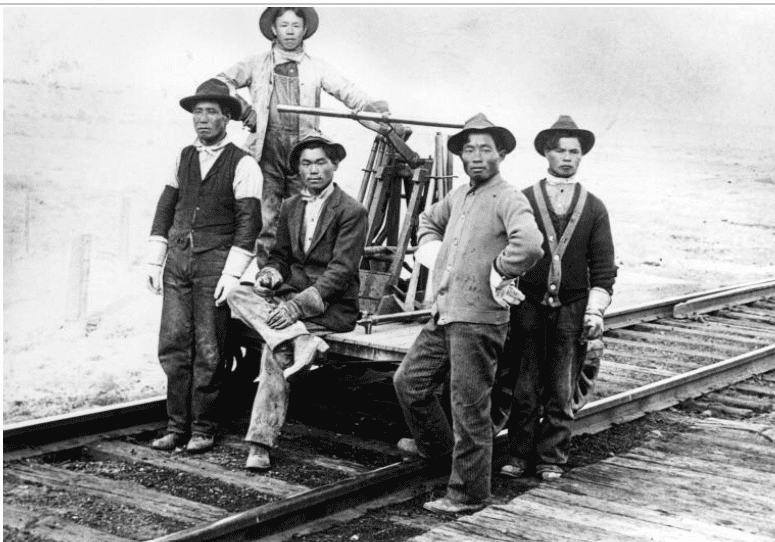
Large-scale Chinese immigration began after the California Gold Rush and accelerated with construction of the western railroads. Thousands of Chinese laborers worked on the Central Pacific portion of the transcontinental railroad and later in agriculture, mining, manufacturing, laundries and other businesses.
The Chinese population in the United States grew from about 35,600 in 1860 to 105,600 in 1880.
By 1880 there were roughly 105,000 Chinese-born people in the United States, overwhelmingly in the West. That was actually a tiny fraction of the national population, but the concentration in California made their presence much more conspicuous.
Economic competition became intertwined with overt racial hostility. Chinese workers were accused of depressing wages and taking jobs from white workers. Labor organizations became particularly important proponents of exclusion.
The Barn
Why did Chinese workers come to California in such numbers in the first place?
The Mack
The first big attraction was the California Gold Rush after 1848. Conditions in southern China also pushed migration: poverty, political turmoil and warfare, while California offered wages enormously higher than those available at home. Many migrants were young men who viewed America—Gam Saan, the “Gold Mountain”—as a place to earn money and eventually return to China.
After the Gold Rush came the trans-continental railroad.
Chinese worked for $30 per month; white Europeans received $35 per month plus room and board… big savings for Central Pacific RR
The railroad didn’t initially hire Chinese workers because it preferred Chinese people. It hired them because it needed labor. Once employers discovered that the workers were productive and comparatively inexpensive, they wanted more of them.
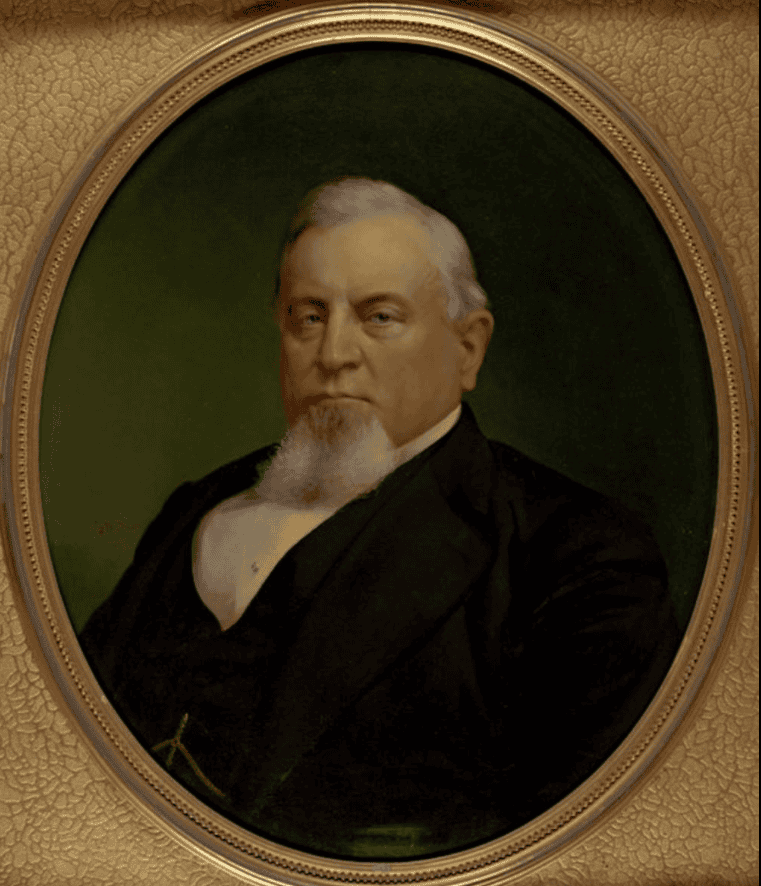
Charles Crocker, Central Pacific RR
Central Pacific desperately needed labor in 1865—it had work for perhaps 4,000 men but could retain only around 800. Crocker pushed the idea of trying Chinese labor despite strong objections from construction superintendent James Strobridge. They started with about 50 Chinese workers. Their performance changed management’s opinion dramatically, and eventually Chinese workers constituted perhaps 80% of Central Pacific’s construction workforce. Crocker later recalled that when they needed something done quickly, they learned it was often better to put Chinese crews on it.
Eventually, about 11,000 Chinese workers were working on the Central Pacific by 1868. The company’s attitude changed dramatically. Chinese workers acquired a reputation among Central Pacific management for being reliable, efficient and remarkably capable workers.
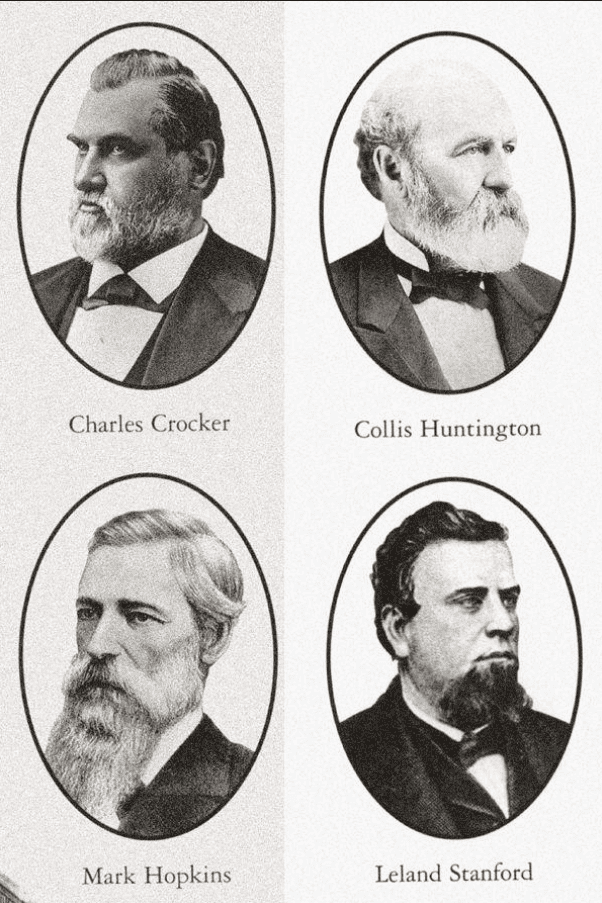
The Big Four of the Central Pacific Railroad
The Barn
What did Chinese immigration do to the American labor market?
The Mack
A couple things. So the nominal wage difference—$30 versus $35—understates the real disparity. The National Park Service estimates Chinese workers’ overall compensation was about 30% lower than European and European-American workers once the different treatment is taken into account.
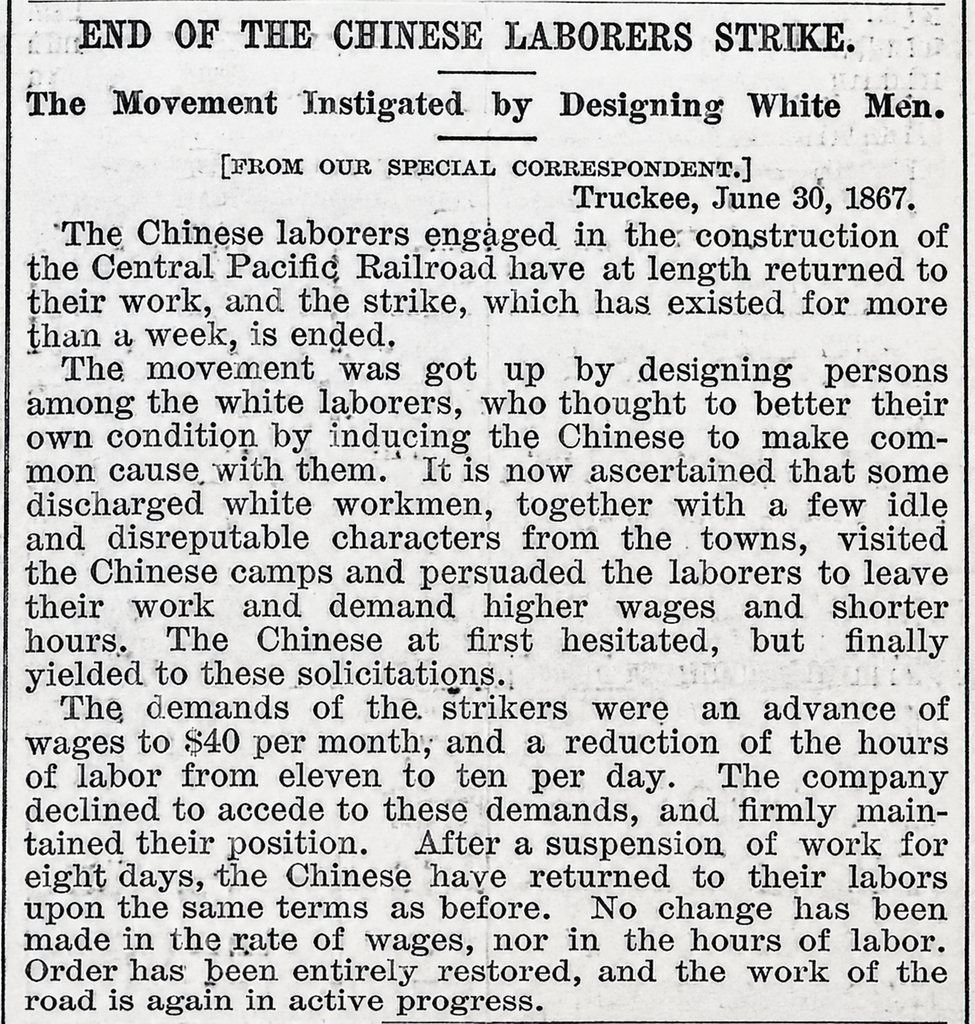
The disparity was maintained by a familiar tactic, used throughout our history… busting the workers’ strike.
Crocker and the Central Pacific cut off supplies to the Chinese to force them to drop their demands and return to work
Secondly, the Chinese experience suggests something much more interesting: immigrant labor can simultaneously compete with some American workers, complement others, lower employers’ costs, increase production and create additional jobs elsewhere in the economy. If you remove that labor, and you have to trace ALL of those effects—not merely count the job that the immigrant previously occupied.
Next up…
1917–1924: America closes the door
World War I, nationalism, labor concerns and fears about the enormous immigration wave changed the political climate. This brought on the biggest immigration-policy reversal in